Dr. Mario Patiño Torres emphasized his strong dedication to upholding institutional integrity, stating, “I would not want to go down in history” as part of the generation that “surrenders” the Central University of Venezuela. Photography: Luis Silvera / Guacamaya.
Guacamaya, November 2, 2025. Dr. Mario Patiño Torres stands out as a leading figure in Venezuelan medical academia. He currently serves as the dean of the Faculty of Medicine at the Central University of Venezuela (UCV), a pivotal institution for training health professionals. Dr. S. prefers to be addressed by both his surnames, honoring his family legacy and values that guide him through his professional and academic career.
His career is distinguished by a profound commitment to academia and public health. He previously held the presidency of the Venezuelan Society of Internal Medicine, which aligns with his specialization. Additionally, he holds a doctorate in Education from the Complutense University of Madrid (UCM) and is a full professor at the UCV’s Faculty of Medicine.
Amidst the recent canonization of Dr. José Gregorio Hernández, also an alumnus of UCV and a national symbol of faith, science, and solidarity, the office of Dr. Patiño Torres reflects a shared historical and spiritual tradition. A notable painting, gifted over a century ago by the National Academy of Medicine, depicting the “Doctor of the Poor” is displayed prominently in his office.
Moreover, a portrait of José María Vargas is proudly exhibited, awaiting the return of a replica of Simón Bolívar’s equestrian portrait, which is currently being restored. Dr. Patiño Torres recalls that Bolívar, on his last visit to Venezuela in 1927, along with Vargas, then the first rector of UCV, founded the Faculty of Medicine – formerly known as the Medical Faculty of Caracas.
This visual heritage illustrates the significance of iconic figures who have shaped the history of medicine and education in Venezuela. The Faculty of Medicine traces its lineage back to the historic Prima Chair of Medicine established in 1763, which laid the groundwork for medical education in the country and continues to thrive through the dedication of Dr. Patiño Torres and his team.
You can watch the full interview in audiovisual format on YouTube:
The University has always been more than just an institution—it symbolizes my life project, with Medicine being my true passion, particularly in teaching.
What inspired your calling to medicine?
Vocation is a concept that can be difficult to articulate objectively. From an early age, I told my parents I wanted to become a doctor. The reasons aren’t clear, especially since I was born in a small town in Bolívar state—Upata—where neither of my parents had any medical background.
I studied under the Jesuits at the Loyola Gumilla School in Puerto Ordaz. I believe a lot of my social sensitivity stems from that Jesuit education. At one point, I even considered joining the priesthood. Ultimately, I chose Medicine, which had always appealed to me. Not just any Medicine, but the Medicine at the Central University of Venezuela.
I vividly remember saying, “I want to be an UCEVIST,” which encouraged me to pursue my undergraduate studies there. Back then, entering the Medicine program required completing a basic cycle, which lasted a year at what is now the School of Nursing in Sebucán. It served as a rigorous filter, and not everyone was able to make it through.
From that moment on, my commitment to becoming a doctor and my devotion to the Central University solidified. The University has consistently represented a life project for me, and Medicine has naturally become my passion, alongside teaching. Notice that I’m pursuing my doctorate in Education, as I felt the need for greater tools to enhance my role as a university teacher.
The Faculty of Medicine successfully trains around 1,200 health professionals annually, with 600 students in undergraduate programs and about 600 in postgraduate specialties, a tradition that has maintained itself over the years.
Regarding the responsibilities you mentioned that ultimately led to your deanship, what do you identify as the key challenges currently faced by the Faculty?
The challenges are not isolated to the Faculty; they extend throughout the entire University. The Central University of Venezuela, as a public and autonomous institution, has endured an induced collapse over the past two decades, compounded by over a decade of budget redirection that leaves us in a survival mode.
Nonetheless, this University is still the leading institution in the country and ranks among the top 35 in Latin America—despite lacking a budget. Can you imagine the potential of the Central University if the state would allocate the budget it is constitutionally obliged to provide?
Many wonder how the Faculty continues to operate under such circumstances. The truth is, it comes at a significant human cost. Our faculty is not only diminished in number but is also working under precarious living and working conditions. Yet, we persist in fulfilling our responsibilities.
The Faculty of Medicine continues to develop around 1,200 health professionals each year: 600 undergraduate and 600 specialist postgraduate students, a noble mission that demands recognition not only for our teachers but also for the administrative and support staff, as our university community is essential for its functioning.
Sometimes, I wake up wondering if it makes sense to continue, but the answer always remains yes, because this University deserves it, the Faculty deserves it, and this legacy must be preserved. I often state I would not like to be remembered as part of the generation that abandoned the Central University of Venezuela despite the many adversities.
If a faculty facing such challenges is given the go-ahead to enroll 200 students per year, they would resign immediately, closing our medical schools.
Since the COVID-19 pandemic, the delay in admissions activities has been reported, sometimes extending up to a year. Has there been any resolution with respect to this issue? If not, what proposals have been made to mitigate this situation?
I’d like to mention that the Faculty of Medicine is not limited to training future doctors; it’s a hub for Health Sciences. It comprises six schools, including two Schools of Medicine—“José María Vargas” and “Luis Razetti”—alongside the Schools of Bioanalysis, Nutrition, Nursing, and Public Health.
In the specific case of the two Schools of Medicine, the lack of graduates in 2021 due to the pandemic resulted in two cohorts waiting to be admitted. This year, we can finally enroll the students from the 2023 cohort.
During our initial two years of leadership, we identified significant issues that needed resolution and faced limitations that extend beyond administrative concerns.
The issue of salary is indeed an academic one. Without well-compensated educators in acceptable conditions and lacking basic social support, we remain challenged.
A faculty in such precarious conditions, when tasked with admitting 614 cumulative students—well beyond its capacity—would undoubtedly lead to mass resignations, forcing us to close our medical schools.
Where lies the resolution? It’s essential to allocate resources effectively to ensure fair compensation for faculty, accommodate 614 students, and enhance educational resources. Without the necessary conditions, and facing pressures to enroll hundreds more students, we quickly identify that the quality of education would be severely at risk.
From the start of our administration, we have meticulously prepared a project through Academic and Administrative Coordination aimed at addressing this situation: 1) Immediate allocation of the needed resources, and 2) our readiness to tackle this urgent problem.
This project was persistently presented to the Minister of University Education, Professor (Sandra) Oblitas, and her successors, particularly Professor Ricardo Sánchez, through various channels, yet we have yet to receive a response.
We appreciate that the national situation inherently limits resource availability and prioritization but wish to convey to the community that this is not a reflection of neglect from the Faculty’s authorities. It is a challenge we wish to address promptly, resonating with the young people and their families who have waited up to two years.
 The dean recognizes the significance of historical references in medical training in Venezuela. Photography: Luis Silvera / Guacamaya.
The role of José Gregorio Hernández in our University and national medical education has been established for decades, and his legacy didn’t emerge with the recent canonization.
Following Dr. José Gregorio Hernández’s canonization, making him the first Venezuelan saint, what does this signify for your students, especially for those in training?
The canonization is a significant event that brings joy; it universalizes the figure of José Gregorio Hernández. He has been an essential reference for training Venezuelan doctors for over a century. Passing away in 1919, his legacy transcends spiritual dimensions and takes shape academically as well.
Hernández was an alumnus of our University, graduated from this Faculty, and served as a distinguished researcher for 28 years, contributing to both fundamental and applied research. Notably, he conducted groundbreaking studies on ischemic heart disease related to malaria.
He founded the first laboratory of experimental physiology and microbiology connected to Vargas Hospital, marking it as the first microbiology lab in Latin America. He transformed pedagogical practices and medical education alongside his practice as a physician.
This enduring legacy exists. Recently, in addition to his canonization, he was declared (by the Archdiocese of Caracas) the “Patron Saint of Venezuelan Doctors,” a title that acknowledges his impact. However, I reiterate: Hernández’s influence on our University and national medical education has persisted for decades, and this legacy isn’t a new phenomenon.
José Gregorio is ingrained in the university culture and medical training at our University and Faculty, and I believe this holds true across all medical schools in the nation. Venezuelan doctors possess distinguishing characteristics, which is no coincidence. Historical figures in national medical education contribute unique attributes and identity.
About 40,000 graduates come from our Medicine faculties located within public and autonomous universities, alongside a few experimental universities.
Speaking of the Venezuelan doctor’s vocation in relation to the exodus, many graduates have to practice their profession abroad. Do you think this humanist vocation is equally acknowledged in other countries?
I have no doubt about it. The distinctive features of our doctors are evident. We build on the legacies of icons, such as Dr. José Gregorio Hernández, which uniquely shapes our medical training.
Medical humanism is inherently linked to our education, although the teaching model sometimes leans heavily toward the biological. Nevertheless, this humanistic approach persists and distinguishes our doctors. It’s worth noting that those who experience our services in different places validate this through their high regard.
Around 40,000 have graduated from our faculties across public and autonomous universities, and a handful of experimental ones. While it’s disheartening, no one can deny a young person’s desire to seek better opportunities in other locales.
I always mention that for foreign countries, it’s a fantastic deal. One nation trains exceptional human resources, while another reaps the benefits without any financial investment. It’s a painful reality for Venezuela. Imagine the investment needed to train a doctor. It requires years and significant economic resources, while another nation benefits without contributing anything. It’s simply unjust.
We must take it upon ourselves to rebuild our nation, which involves overcoming ingrained challenges and mechanisms that have been structurally embedded in our society in recent decades. We must continue working diligently from this platform to realize the great nation that we all aspire to and truly deserve.
We can’t continue on this path of confrontation because we have seen its consequences: a disjointed nation facing substantial value losses that have left us with numerous limitations. The only way to rebuild is for all sectors to unite around a greater cause: the well-being of our people.
 Dr. Mario Patiño Torres highlights the ongoing crisis but also acknowledges the diligence of health professionals still operating within the country. Photography: Luis Silvera / Guacamaya.
We persist in training 1,200 health professionals annually, even amid resource scarcity, a reallocated budget, and extremely challenging working conditions.
What do you identify as the main challenges to ensuring the right to health in Venezuela today, especially with regard to supply shortages and the alleged “covert privatization” of medical services?
Since 2017, we have been under a declared humanitarian crisis that remains unaddressed. This situation compels health professionals to strive for excellence, despite the limitations we face while working in hospitals that lack numerous essential resources.
However, I tell my students that the worst fate for patients who can only access public institutions is to be left without medical care. Thus, I aim to advocate for our doctors. While 40,000 are leaving, many young and experienced professionals remain committed to doing their best.
I seek to engage allies for communication efforts to highlight the dedication of our current and emerging health professionals, including doctors, nurses, nutritionists, and bioanalysts, who continue their work in the country. Without them, the majority of the population would find themselves in worse conditions.
Our challenge as trainers of human resources is to persist in our mission. I emphasize that we continue to develop 1,200 health professionals each year, notwithstanding the lack of resources, a repurposed budget, and substandard working environments, but this remains our duty.
We aim to create examples and role models to inspire younger professionals to consider practicing in our country, rather than viewing emigration as their only option.
Many faculties report that up to 95% of their students drop out in the first year as they struggle to meet academic standards.
In 2022, the Government initiated the “Special Plan to Repair and Revive the National Public Health System,” which promised recovery of infrastructure and enhancement of health centers. What is your assessment of this launch three years later, and what barriers have you encountered in executing this plan?
Yes, this should be an obligation of the State, not merely a promise. We must ensure a dignified healthcare system where all Venezuelans can access medicine without exclusions. It is unjust that disadvantaged groups are subjected to subpar medical care.
Some progress is visible, particularly at the University Hospital of Caracas, where restoration has not only improved the infrastructure but also enhanced equipment availability, facilitated by dedicated hospital authorities.
Additionally, the University holds a formal role in managing the University Hospital, with participation from both the rector and the Faculty dean on the Board of Directors. This illustrates collaborative efforts, although it clearly calls for significant resources.
However, under an economy severely compromised by various factors, we recognize that financial resources are limited, hindering the proposed pace of advancements in the plan launched in 2022. Money dictates what can be accomplished. Without it, the intended goals cannot be achieved.
If there is a will and if we unite over higher purposes aimed at genuinely uplifting our population beyond individual or political interests, then we can revive not only healthcare but also education, which also suffers greatly.
Concerning incoming students, we are concerned about the level of preparedness they bring. Many faculties report a 95% dropout rate during the first year due to their inability to meet educational standards.
I believe that this moment presents a tremendous opportunity for our country to recreate its structures, not just infrastructure but also institutions and the fundamental functions of the State: healthcare, education, and security. There is immense work to do, and I hold great hope for new generations.
Graduates from Integrative Community Medicine are increasingly interested in pursuing specialties, despite this not being the program’s original intent.
In the realm of academic training, particularly in Health, the Government-established University of Health Sciences emerged over a decade ago to train medical personnel and strengthen public healthcare systems. How do you assess its impact and the main challenges it faces?
The National Training Program for Integral Community Medicine was established in 2005, graduating its first cohort in 2011, which resulted in approximately 8,600 comprehensive community doctors. Its aim was to provide primary healthcare doctors capable of addressing common health issues.
Regrettably, this vision became distorted over time. Many graduates now wish to pursue specialties, a departure from the program’s goals. This program included the Comprehensive General Medicine postgraduate degree, akin to a family doctor in other nations. What once was a noble initiative has now deviated from its original purpose.
For many years, we (the UCV School of Medicine) have aimed to harmonize the training of healthcare human resources in the nation. With a 263-year history in training health professionals, why not leverage our experience for the greater good?
When I say “harmonize,” I don’t mean to unify, but rather to establish reference points that allow all universities, including the University of Health Sciences, to meet common standards in training healthcare professionals. Why should we maintain such dissimilar programs that fail to fulfill their original aims while not creating a collaborative environment?
Previously, a platform called the Venezuelan Association of Schools and Faculties of Medicine (Avefam) facilitated this dialogue until around 2015, when it ceased activities due to funding issues. The deans from all medical faculties convened there. With the new University of Health Sciences, we could devise national public policies for professional training.
We have repeatedly proposed reforming or reactivating Avefam to establish a space that develops public policies for this new university, which has inherent weaknesses due to its youth. Why not utilize our quarter-millennia of collective experience?
In that regard, I understand that the University of Health Sciences has valuable pedagogical resources and simulation rooms, which we lack at Central University of Venezuela. Why can’t we share those resources? We can provide them guidance on educational theory and policies while utilizing their facilities in return. Collaboration is essential for nation-building.
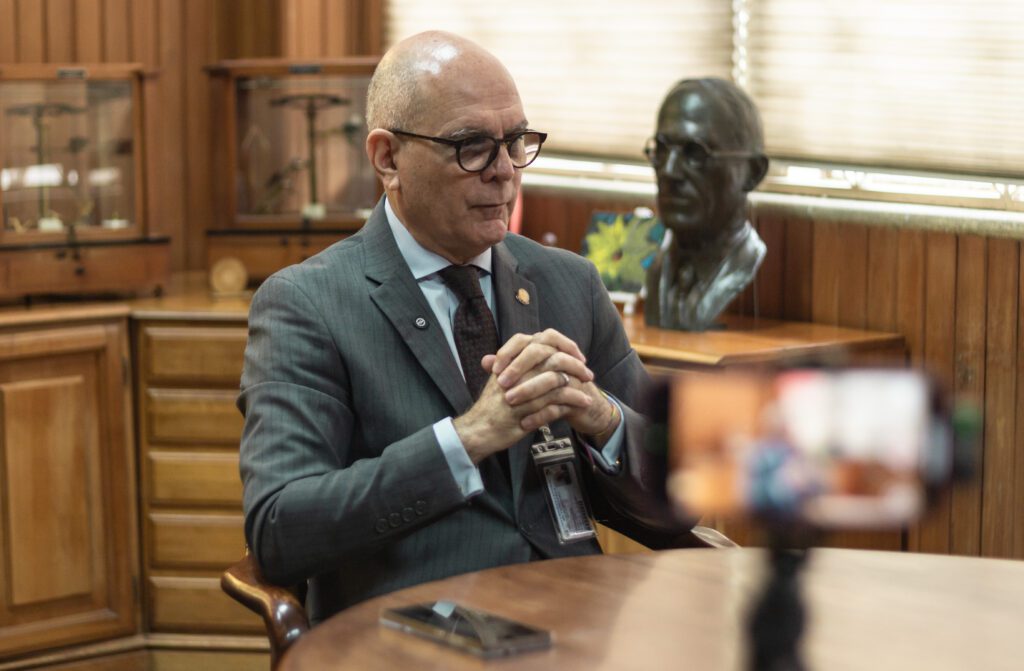 The dean of the UCV School of Medicine advocates for collaborative solutions and critiques structral failings. Photography: Luis Silvera / Guacamaya.
In light of your call for public policies, if you could address the challenges associated with the current healthcare situation, what would your top priorities be? Where would you begin?
The first priority is to create spaces for collaboration. We could develop projects at UCV’s Faculty of Medicine to tackle both training and healthcare. If such initiatives face roadblocks, we must prioritize creating an environment that allows us to think critically about the nation we wish to build.
Regarding specific educational policies, we have over 20 years of experience in curricular transformation processes at the Faculty of Medicine. Upon returning from my doctoral studies, I devoted my time to this. This is a 300-year-old university with proven achievements, and yet these must be adapted to modern times.
Addressing health service provision is much more complex and might not align strictly with my expertise, but we have qualified individuals who can tackle this. Many members of our management team possess training in health management.
There are numerous talented individuals ready to harmonize training and healthcare policies that ensure equitable, dignified service, providing every Venezuelan with rights to competent medical care with adequate resources.
This model of public university, reliant on public funding without adequate support, is outdated.
Should healthcare in Venezuela be public or private?
I admire nations with robust public health systems, like Spain. Their public healthcare is well-resourced and often surpasses that of the private sector. Citizen taxes fund these hospitals with proper equipment and qualified staff. Socialism, as we often misconceive, entails a system of social justice ensuring that health, education, and security are accessible to all citizens.
This public university model reliant on the government treasury, which currently provides little, is unsustainable. University authorities must seek management frameworks that ensure, in addition to the constitutionally mandated budget, the ability to secure independent financing.
We are working to establish a management system that facilitates genuine collaboration between public and private clinical institutions, fostering the financial autonomy the Liberator envisioned when he donated land to ensure the University’s sustainability.
In this regard, we’re not discussing profit. It’s about ensuring the University operates independently from a standard fiscal budget which, as we know, speaks to current realities. I often mention that even if we received 100% of the requested budget, the University’s complex structure would still fall short.
In light of the current weaknesses, opportunities, strengths, and threats, how do you envision the future of Venezuelan medicine in the next 10 to 20 years?
I believe that if we remain committed to perseverance, continuously believing in improvement opportunities while maintaining our current practices of generating quality human resources, we truly have the potential to build the nation I have envisioned since childhood.
We’ve highlighted weaknesses during our discussions, plus ongoing challenges, and there are even structural corruptions within the University that require attention. While the University embodies numerous virtues and values, it’s essential to acknowledge the vices and corruption pervasive in our structure.
Our management has three guiding premises: 1) deliver efficient management within limited resources, 2) ensure transparency so irregularities may be reported and addressed as needed, and 3) promote collaborative efforts.
I am proud to say that after two years, a dedicated team filled with commitment and shared aspirations has been formed. Our ultimate goal is to enhance the quality of our Faculty of Medicine, so that when we pass on our responsibilities next July, we do so with a significantly improved institution.
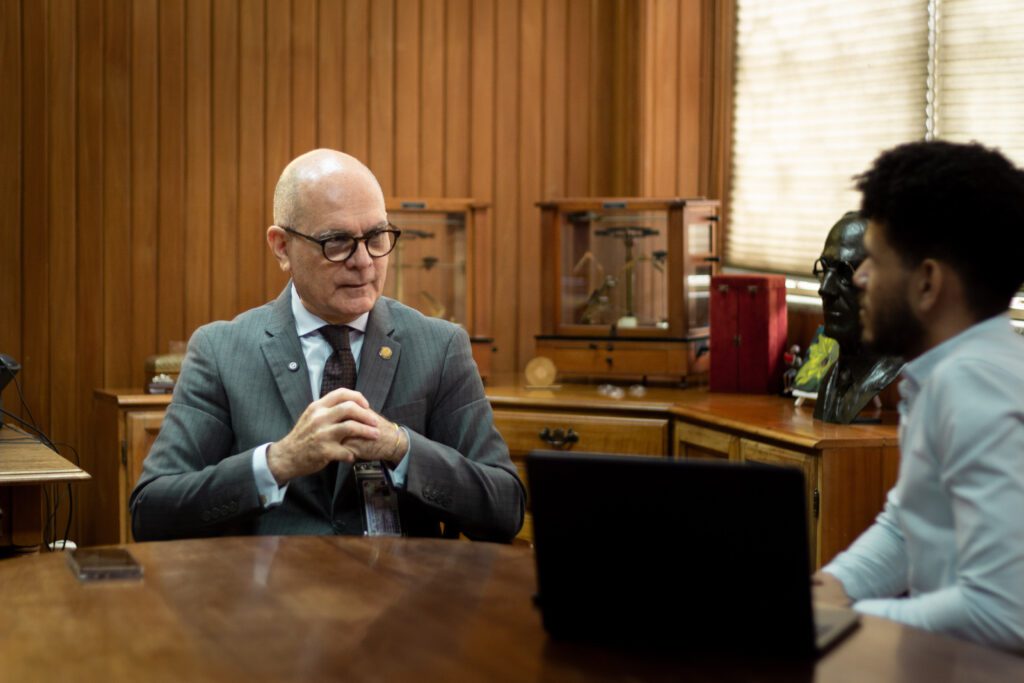 The dean of the UCV School of Medicine asserts that the foundation of his management is grounded in efficiency, transparency, and collaboration to deliver a superior Faculty. Photography: Luis Silvera / Guacamaya.
We are the premier university in Venezuela and rank 35th in Latin America—not by coincidence.
What role will UCV play in the reconstruction you envision for the coming years?
The generation of knowledge is key. Our status as the foremost university in Venezuela and the 35th in Latin America isn’t arbitrary. It reflects our unwavering commitment to knowledge generation despite limited resources—fundamental to any university’s mission globally, facilitating growth in all facets, including scientific and technological advancements.
Furthermore, we must emphasize the importance of community outreach, which the Faculty has actively pursued—ensuring our undergraduate and graduate students engage in service-oriented projects benefiting society.
Despite having graduates from the Integrative Community Medicine program numbering around 50,000, we still fall short of WHO’s standards for doctors per population ratio. Thus, we must continue training high-quality human resources.
Without adequately educated instructors in new technological advances, how can we expect students to receive effective training?
As for innovation, how has the University, particularly the Faculty of Medicine, coped with technological advancements like Artificial Intelligence in academic training and medical practice?
Since 2010, we’ve entered the Fourth Industrial Revolution, landing us in “Health 4.0.” This revolution has drastically evolved over just 15 years, at an unprecedented pace.
This extends beyond Artificial Intelligence; it’s about creating an entire interconnected ecosystem encompassing Big Data, cloud technology, IoT, and blockchain. The pressing concern now is how we incorporate Artificial Intelligence effectively while integrating these advancements into the curriculum for both undergraduate and graduate programs.
In terms of Artificial Intelligence, we are still at a nascent stage when it comes to its rigorous incorporation into medical education. We strive to approach this responsibly, albeit with limited resources, which presents challenges, though these limitations should not be our excuse for inaction.
Significantly, teacher training in these technological facets is crucial. If teachers are not well-informed, how can they train the students? Thus, our primary focus is to equip faculty members with the necessary skills to effectively impart knowledge.
Additionally, we must establish quality control measures to evaluate AI-generated recommendations. Algorithmic bias poses one of the significant challenges since AI depends on the data fed into it. The question remains: How much data are middle- or low-income nations like us contributing?
High-income countries and tech giants largely shape model learning data. We must examine the representation of our population within AI-generated recommendations, as the lack of proper representation can perpetuate discrimination within medical education.
We should exercise critical reflection when utilizing AI’s offerings since these recommendations may not necessarily apply to our context. This ongoing challenge will encourage us to also contribute data so that we are adequately represented, thereby mitigating historical discrimination in medical education.
Research serves as a cornerstone, complementing teaching and community outreach. Our role is not solely to transmit information; we are here to generate knowledge. Currently, a major goal is to share our research endeavors and capabilities, contributing our data to Artificial Intelligence.
Instead of establishing new medical schools, why not reinforce existing, historically significant faculties?
Finally, what message do you have for young Venezuelans aspiring to study medicine in our country?
A great many aspire to study medicine, historically the most sought-after field at the University; recent data from Simadi indicates the demand for the Medicine program far exceeds all others, with social communication following closely behind.
We need doctors; the nation still lacks sufficient professionals. However, students must recognize our capacity is limited. We estimate that each medical school can accommodate roughly 200 students annually, being the maximum we can train with the resources we have. So please don’t expect more from us, as there’s simply no capacity for further admissions, and we cannot be held responsible for it.
This challenge originates from insufficient state funding. Rather than creating new medical schools, let’s bolster existing faculties with their substantial historical achievements and expertise. Let’s allocate resources to universities with experience and trained faculty instead of diluting them across less-established institutions.
The core message is to remain steadfast in pursuing their ambitions; those determined to become doctors should persist. The Faculty of Medicine has devised three admission methods, with the Samuel Robinson Program adding a fourth option. Prospective students can apply through the OPSU (Office of Planning of the University Sector), the Simadi test, or our additional preparatory course.
Usually, the motivated and high-achieving candidates will garner acceptance. Medicine demands extensive prior knowledge—not only nationally but globally. High standards are enforced regarding admission eligibility.
To those students, I say: Don’t lose heart. I was once that little boy in Upata who dreamed of becoming a doctor and now here I am at Central. Achieving a life purpose requires persistence, and I firmly believe that if done with genuine conviction, success is possible.