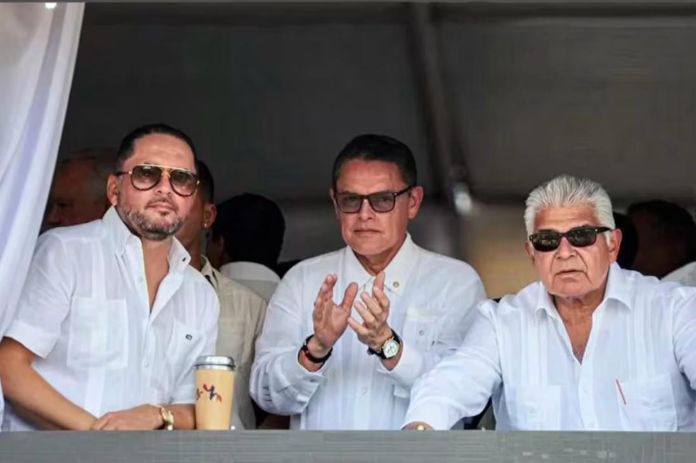
 Félix Fallabella (Izq.) in the presidential box on November 5, 2025. This time, alongside his friend, Security Minister Frank Ábrego (center), and President José Raúl Mulino (right). Photo: Prensa de Panamá
Last September, Cuentas Claras Digital disclosed the political and business connections of Panamanian Ramón Carretero Napolitano with the Venezuelan regime, linked through his partner Carlos Malpica Flores, following the crash of the Learjet 55 registration YV3440 that occurred at the Simón Bolívar International Airport in Maiquetía. At that time, we warned that the disaster involved not only a key operator but also uncovered a network of private flights between Venezuela, Panama, and Cuba, used by powerful figures for illegal businesses.
New documents released by Armando.info expand on and confirm our earlier findings: the accident revealed an air bridge reserved for operators of two dictatorships, with frequent flights connecting Caracas and Havana to Panama, involving high-ranking Cuban military, diplomatic officials, and businessmen favored by the Venezuelan regime.
Ramón Carretero, Panamanian businessman linked to Maduro, survives plane crash in Maiquetía
According to records revealed by Armando.info, the crashed aircraft – Learjet YV3440 – made at least 18 flights between Panama, Caracas, and Havana. Among the passengers, a name of significant political weight appeared: Raúl Guillermo Rodríguez Castro, a Cuban colonel, head of security and grandson of Raúl Castro Ruz, a central figure in the repressive apparatus and inner circle of power of the Cuban regime. His presence on these flights indicates that the Caracas – Havana connection goes beyond ideological cooperation, operating at logistical, private, and opaque levels.
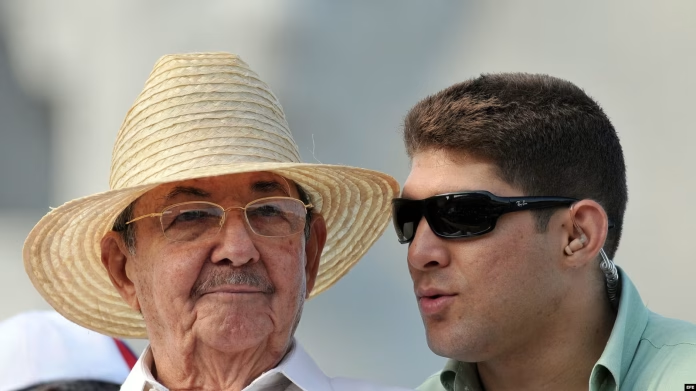 Raúl Castro with his grandson and bodyguard Raúl Guillermo Rodríguez Castro
The investigation suggests that Edwin Pitty Madrid, an employee of Carretero’s business group, was appointed Panama’s ambassador to Cuba, confirming an influence network that transcends business. Diplomacy, private aviation, and contracts with the regimes of Venezuela and Cuba are all part of the same structure. This aspect had not been officially reported and shows how Panama has functioned as a link between the interests of the Venezuelan regime and the Cuban elite.
As CCD informed in September, Carretero built his influence thanks to his close ties to the Venezuelan regime and support from the Cuban apparatus. With the mediation of Carlos Malpica Flores, he obtained multimillion-dollar contracts through his company Lanvicorp, including the construction of the Hugo Chávez baseball stadium and the renovation of hotels in Vargas. He has also been involved in the trade of arms, appliances, sports equipment, and even toys, with his main economic activity being the oil sector – PDVSA – which solidified his position as a privileged contractor within the economic web of Maduro’s regime.
The YV3440 accident was not an isolated incident. It marked the breaking point that allowed us to showcase what we had denounced: a network of private operations connecting two dictatorships through businessmen who have acted for years as intermediaries, facilitators, and privileged suppliers.
Sources from CCD indicate that international security agencies suspect Ramón Carretero Napolitano and his partner and relative, Félix Falabella Napolitano, may have ties to the CIA. This would explain the impunity they have enjoyed so far, despite their repeated trips and operations over the years in the Panama-Cuba-Venezuela triangle.
What occurred in Maiquetía was the visible tragedy of a structure designed to operate outside scrutiny, far from controls, and with unlimited access to state resources.
This pattern is not limited to Venezuela. A recent investigation by a Panamanian newspaper revealed that Raúl Guillermo Rodríguez Castro – grandson of Raúl Castro – uses Panama as a platform for private operations, frequently flying in executive jets to acquire goods and circumvent embargo restrictions. These findings confirm that Panama has become a strategic point for the discreet movements of Havana’s elites, alongside the already documented air corridor between Caracas and the island.
The Venezuelan regime’s reaction to the accident has been characterized by secrecy: the identities of the deceased have not been disclosed, the real passenger list was not reported at the time, and no explanations were provided regarding the causes of the disaster. With these new revelations, this silence makes sense: the aircraft transported operators whose public exposure directly compromised Caracas and Havana.
 Ramón Cerretero Napolitano
However, the secrecy continues. Little is known about Ramón Carretero’s current situation beyond that he is hospitalized at the Hospital de Clínicas Caracas, recovering from severe injuries sustained in the accident. Surrounded by intense security measures, information about his health status is scarce, even for his close ones.
Questions about this case remain, along with new ones that are emerging:
1.- What was the cause of the air crash? Was it really an accident?
2.- Who were the passengers on the plane, who died?
3.- What explains the regime’s secrecy?
4.- Why is Ramón Carretero isolated?
5.- Why is there silence from the Panamanian media, given that he is one of the country’s main businessmen?
6.- Why did José Mulino – president of Panama – appoint an employee of Carretero as ambassador to Cuba?
7.- How are the various businesses that Carretero maintained with Carlos Erik Malpica Flores, especially those related to PDVSA, currently being managed?