A journalistic investigation by VenezuelaPolitica.info into the multimillion-dollar contracts awarded to Corpoelec during Argenis Chávez Frías’s administration faced repercussions from Google following a false copyright claim. The platform blocked monetization and removed the page from its search results. The author of the report denounced this as a false claim and warned of a much larger issue: the use of the U.S. copyright system as a tool to erase investigations, sanitize reputations, and manipulate the public record on the internet.
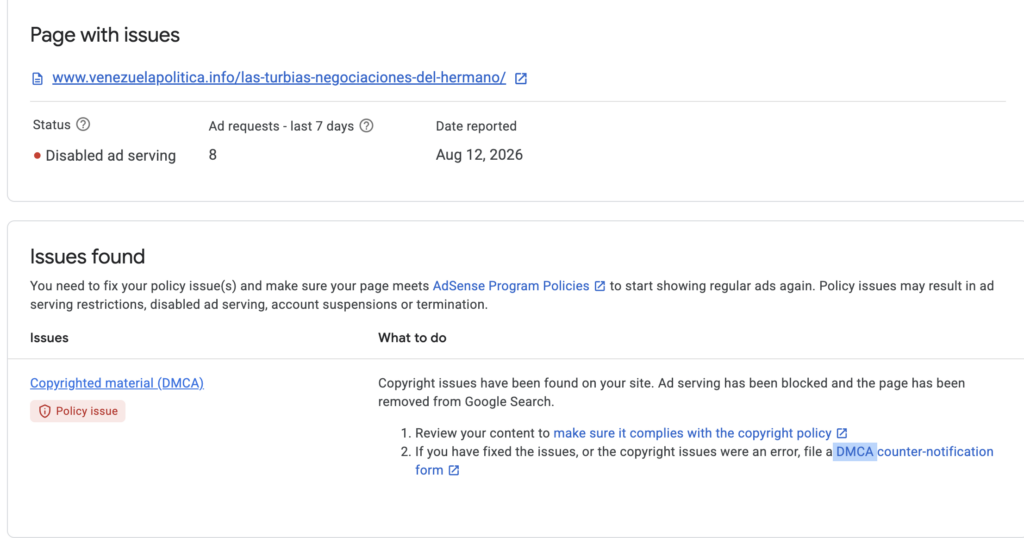
On August 12, 2026, VenezuelaPolitica.info received a notification that any digital media outlet fears receiving. In the Google AdSense Policy Center, a sanction against a specific page of the site appeared: an investigation titled “The shady dealings of Hugo Chávez’s brother at the helm of Corpoelec”.
The message was clear: “Copyrighted material (DMCA)”.
Google also informed that it had blocked ads from appearing on that page and that the article had been removed from Google Search due to alleged copyright issues. The platform offered two alternatives: modify the content to comply with its policies or, if the claim was erroneous, submit a DMCA counter-notification.
The fundamental issue is that the contested report was written by me, Maibort Petit, and published as part of my journalistic research work.
I am not in a dispute for having deliberately reproduced the work of another journalist who doesn’t even exist. What I am denouncing is something much more serious: the use of a copyright claim to make a journalistic investigation disappear from the world’s most important search engine and simultaneously lose its ability to generate advertising revenue.
The report that vanished from Google
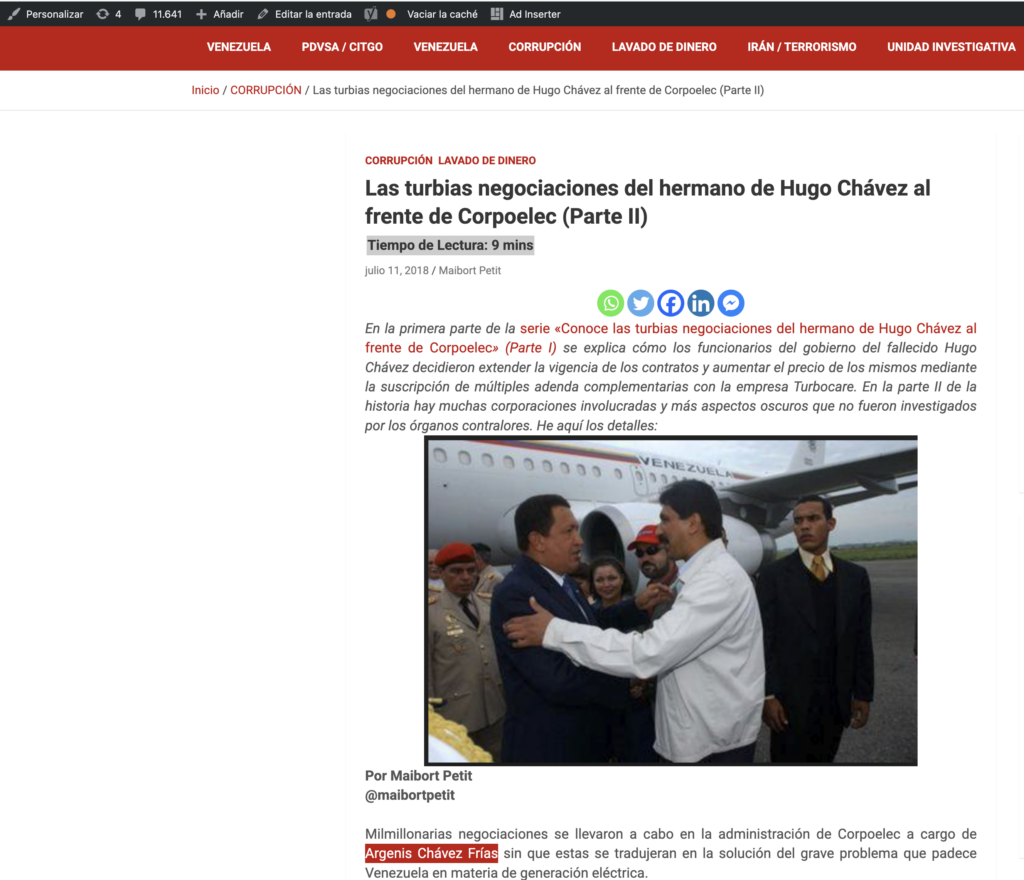
The investigation examined multimillion-dollar contracts awarded during the administration of Argenis Chávez Frías, brother of the late president Hugo Chávez, at the helm of Corpoelec.
The report documented contracts, contract extensions, price increases, amendments, and companies involved in operations related to the Venezuelan electrical system. The central question was evident: how could operations of such magnitude be carried out while Venezuela continued to suffer from a deep crisis in electricity generation and supply?
The article is part of a journalistic series that reconstructs operations, administrative decisions, and corporate relations based on documentation and evidence gathered during the investigation.
Years after its publication, the report faces a different threat. Not a refutation accompanied by documents. Not a request for correction of specific data. Not a lawsuit requiring the parties to present their evidence in court.
A copyright claim. And its consequences were immediate.
When the DMCA becomes a weapon
The Digital Millennium Copyright Act, universally known as DMCA, was enacted in the United States in 1998. One of its mechanisms allows rights holders to request service providers to remove material they consider infringing.
The system has a legitimate reason to exist: to protect creators and owners from unauthorized use of their works.
The problem arises when that mechanism is used for something entirely different: seeking to remove legitimate information by claiming rights the claimant does not possess or making materially false representations about an alleged infringement.
U.S. legislation precisely contemplates this risk. The 17 U.S.C. §512(f) establishes consequences for anyone who knowingly and materially misrepresents that a specific material or activity is infringing copyright.
Thus, a DMCA claim should not be socially treated as proof of plagiarism. It is an allegation, and can be contested through the procedures outlined in the legislation itself.
The enormous power of a claim
For a small independent media outlet, the consequences can be devastating. A removed page from Google loses one of its main discovery channels. Moreover, if advertising is blocked, the punishment has a second dimension: it simultaneously reduces the visibility and income of the media that published the investigation.
That’s the problem this case forces us to discuss.
When a platform receives a copyright claim, what level of verification exists to determine who actually wrote the article? How is it established who owns the rights? What happens when the person receiving the claim is precisely the journalist who originally produced the investigation?
The system is designed to favor quick responses because platforms have strong legal incentives to process takedown notifications that meet certain requirements. But that speed can turn into a vulnerability when someone learns to exploit the procedure.
The journalist is then in a paradoxical position: they must prove they have the right to publish their own work after another person has succeeded in challenging it through a claim.
The new industry of digital removal
The problem transcends VenezuelaPolitica.info.
In recent years, an international industry of reputation management, content removal, and suppression of negative search results has developed. There are legitimate services dedicated to improving the digital presence of individuals and companies. The problem begins when reputation cleaning crosses the line into deception, rights impersonation, abusive claims, or mechanisms aimed at eliminating legitimate journalistic information.
For someone exposed by investigations into corruption, organized crime, questionable businesses, or abuse of power, deleting an article from Google can be immensely valuable.
There’s no need to destroy the server where it’s published. It’s enough to ensure no one can find it. And that difference is crucial to understand censorship in the age of search engines. A report can technically still exist on the Internet while simultaneously becoming practically invisible to millions of people.
A journalistic investigation does not disappear because someone complains
The claim against VenezuelaPolitica.info raises questions that deserve answers. Who exactly submitted the claim? What work did they assert they owned? Which specific fragments did they claim infringed their rights? What is the relationship between the claimant and the individuals mentioned in the investigation? Is there a reputation management company behind the process? Have similar claims been submitted against other articles or journalists?
These questions must be investigated before attributing individual responsibilities. It’s also essential to establish a critical legal distinction. It is not enough to suspect that a specific individual ordered a fraudulent claim to assert it as fact. That connection must be demonstrated through documentation.
For this reason, VenezuelaPolitica.info will preserve notifications, communications, records, dates, URLs, authorship documentation, and other evidence related to this episode to reconstruct the complete chain of the claim.
Google must also explain its controls
This episode does not mean that Google created the claim or that it necessarily shares the interests of the claimant. But it does raise an issue regarding the architecture of its procedures.
When a claim simultaneously produces consequences on Search and AdSense, the impact on an independent outlet can be extraordinary.
Google has a DMCA counter-notification procedure precisely because takedown requests can be erroneous or disputed. However, damage can begin before this process is concluded.
The imbalance is evident: submitting a claim may be relatively straightforward; reconstructing the necessary documents years later to defend an investigation can prove considerably more complex.
For large media outlets, this presents a legal issue. For an independent journalist, it can become a matter of survival.
21st-century censorship does not always need a court order
For decades, we envisioned censorship as an official entering a newsroom, confiscating an issue, or banning a newspaper. The internet created much quieter mechanisms; it’s no longer necessary to burn the newspaper if you can remove the link, nor is it necessary to close the outlet if you can cut its monetization. Also, it’s not vital to prove that an investigation is false if you can get an algorithm to stop showing it.
And when the systems designed to protect legitimate rights are manipulated for this purpose, the problem ceases to be merely a copyright dispute. It becomes an issue of press freedom, transparency, and preservation of the digital public record.
We will not erase the investigation
VenezuelaPolitica.info will contest through the proper channels any claim we consider false or abusive and will retain the necessary documentation to determine who is behind it. But our primary response will be journalistic.
The report will not be voluntarily deleted. It will be re-investigated, documented, and disseminated.
Anyone who believes that any of their data is incorrect has the right to respond, provide documents, and request the appropriate corrections. This is the normal functioning of journalism.
What cannot be normalized is the use of laws created to protect authors as a tool to erase the work of the authors themselves. Today, the victim is an investigation about Corpoelec. Tomorrow, it could be a report on drug trafficking, corruption, money laundering, human rights violations, or organized crime. That’s why this denunciation transcends a single article and a single media outlet.
If digital silence can be bought, reputation cleaning ceases to be about improving an image and starts to dangerously resemble rewriting history.