Panamanian businessman Ramón Carretero Napolitano managed a significant portion of Venezuelan oil marketing while the United States showcased its military power in the Caribbean waters just months before the capture of Nicolás Maduro on January 3. This was made possible through shell companies registered in China, Singapore, or Hong Kong, alongside the use of a so-called ghost fleet of oil tankers, and the influence Carretero had gained within the state-owned Venezuelan company Pdvsa.
An investigation by Armando.Info, the Latin American Center for Investigative Journalism (CLIP), Transparency Venezuela in Exile, La Prensa de Panamá, and Diario de Cuba, revealed that the companies Hangzhou Energy, Shineful Energy, and Forever Energy Trading dispatched 47 million barrels of crude oil from Venezuelan ports between May and September 2025, based on internal data from the state oil company. The total shipments were valued at approximately 2.6 billion dollars, according to calculations by this alliance based on the average price in 2025 of Merey 16, Venezuela’s primary export oil.
Since Maduro came to power in April 2013, Ramón Carretero has been a key figure in Caracas, closely connected to both the President’s family and that of his wife and First Lady -or First Combatant, as chavista jargon preferred to call her- Cilia Flores, who, like Maduro, is currently facing a trial in New York.
From them, he received dozens of multimillion-dollar contracts, which included the construction of the Hugo Chávez Baseball Stadium (now the Simón Bolívar Monumental Stadium of La Rinconada, in the southwest of Caracas) to the implementation of the Carnet de la Patria, a sort of identification alternative to the national ID aimed at extending the regime’s control over the population in exchange for subsidies. But the biggest deal came years later with the oil sales from Pdvsa when Carretero -like other businessmen close to the regime- became a pawn for Maduro to evade sanctions imposed by the United States.
Neither Carretero Napolitano nor Carlos Malpica Flores, the favorite nephew of Cilia Flores, appear formally in the documents of Hangzhou Energy, Shineful Energy, or Forever Energy Trading. These were shell companies that operated through front men. However, sources within Pdvsa confirmed to this journalistic alliance that the panamanian businessman and Malpica Flores were in charge of those three companies.
Regarding Hangzhou Energy, the American newspaper The New York Times revealed in May 2026 that while its paper-residents were based in China, Carretero Napolitano and Malpica Flores participated on their behalf in meetings with Pdvsa. In addition to serving as Vice President of Finance of Pdvsa, Malpica Flores also was the Nation’s Treasurer. Both he and Carretero were targets of sanctions from the U.S. Treasury Department last December. Eight days later, sanctions were extended to Carretero’s brothers and several members of Cilia Flores’s family.
Malpica’s name had already been included before, in 2022, in the black list of sanctions from the Office of Foreign Assets Control of the U.S. Treasury Department (OFAC). But he was temporarily removed from the list, which was later confirmed, when the Biden administration (2021-2025) sought to negotiate with the Maduro regime for a deal to hold free and fair elections in Venezuela.
This journalistic team accessed internal documents from Pdvsa that allowed them to reconstruct the sales route of crude oil that the companies controlled by Carretero conducted between May and September 2025. This information includes the names of the companies that traded the oil, the dates of those maritime routes, and the destinations of the shipments.
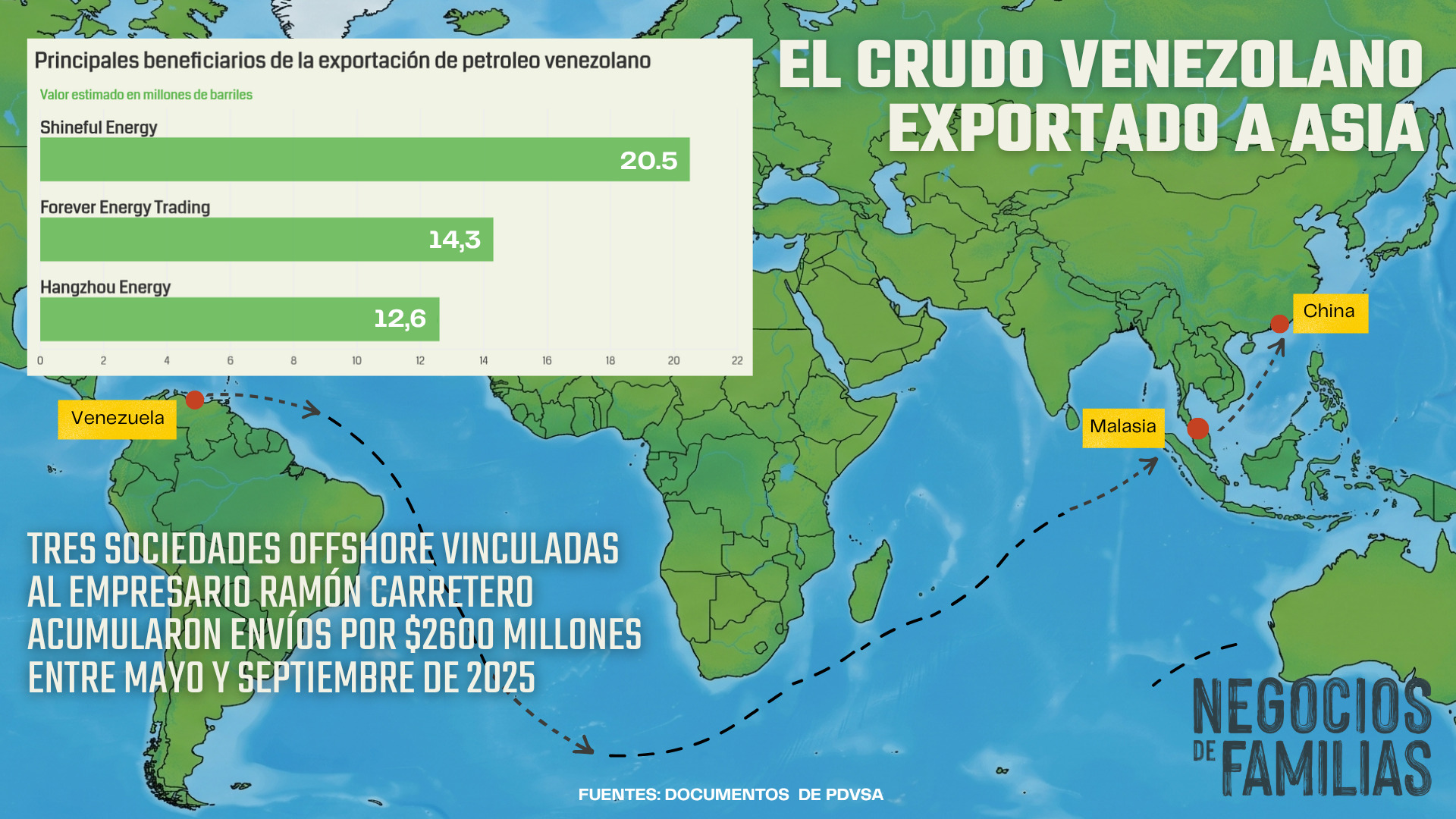
The reviewed crude oil dispatch records show that nearly all the movements of oil made by these three companies had Malaysia as their primary destination, but also other shipments reached the port of Matanzas in Cuba, as part of the ongoing aid to the Castro regime that the Bolivarian Revolution maintained until the events in Caracas on January 3.
Carretero’s link with the Cuban regime, as well as his personal relationship with Raúl Rodríguez Castro, grandson of Commander Raúl Castro Ruz and known in the island as El Cangrejo -a key person in the negotiations currently ongoing between Washington and Havana-, was revealed by CLIP, Transparency Venezuela in Exile, and Armando.Info last December. The logbook of the aircraft in which Carretero had an accident at the Maiquetía International Airport on September 24, 2025, confirmed that El Cangrejo also flew in that aircraft. But Carretero’s influence on the island is so strong that Edwin Pitty Madrid, Panama’s ambassador in Havana since November 2024, represented as a lawyer companies belonging to Ramón Carretero in Caracas as well as family group companies in Panama.
What a bad routing!
The documents reveal that overnight, Malaysia became the main unloading and transshipment point for Venezuelan crude oil since the United States imposed the first sanctions on Pdvsa in January 2019. Since then, China displaced the United States as the main customer for Venezuelan oil, with an average of 283,000 barrels daily. With oil arriving via Malaysia, this country’s oil exports to China -which actually consisted of hydrocarbons coming from Venezuela- registered a 400% increase, according to data from Chinese customs published by Transparency Venezuela.
How did this mechanism work? Tankers chartered by state-owned Chinese companies loaded millions of barrels of Venezuelan crude oil and set course for Malaysian waters, where they transferred oil from one tanker to another to erase the trace of origin. Once this stop was completed, the Venezuelan oil was relabeled as Malaysian blend before entering Chinese ports without setting off customs alerts. Singapore, which appears as the only destination for fuel oil operations, was also cited by experts as another Asian hub for relabeling Venezuelan fuel.
The crude dispatch records examined for this investigation also reveal that for nearly a third of these shipments made in 2025 by offshore companies linked to Carretero, ghost fleet vessels or dark ships were used, often decrepit tankers that deactivate or manipulate their navigation systems at will to hide their movements. A total of 52 operations were carried out with this type of vessels.
The vessel Iria, flagged under the Comoros Islands and classified as stealthy, appears in at least six Hangzhou Energy operations from Venezuela to Malaysia, with a volume exceeding 1.3 million barrels.
The tanker Malak, on the other hand, which sails under the flag of Panama and is sanctioned by the United States, United Kingdom, Canada, Ukraine, and the European Union, served Shineful Energy to move 540,000 barrels of fuel oil to the port of Matanzas in Cuba, according to Pdvsa reports obtained for this investigation, highlighting that the companies controlled by Carretero Napolitano also dispatched Venezuelan fuel for the Cuban regime.
Pdvsa’s documents also reveal the modus operandi of the companies linked to the panamanian businessman. On August 2, 2025, the Nigerian-flagged ship Halima first loaded 1.11 million barrels of Merey 16 crude oil on behalf of Cubametales, a state-owned company controlled by the Cuban military’s business holding Gaesa, which has also recently been subject to sanctions from the United States. Then, on August 4, the same tanker loaded another million barrels of Merey 16, but this time the consignee was Forever Energy Trading, one of the companies controlled by Ramón Carretero.
One of the Pdvsa sources explained that this was because the same ship had to stop first at the port of Matanzas, unload part of the fuel there, and then continue on to Malaysia, where the Venezuelan oil was ultimately traded in cryptocurrencies, making it even harder to track any operation. However, within Pdvsa, there is no record that in those operations the ships first unloaded in Cuba, as seen in the planning of the state oil company.
Last December, the spectacular capture at sea of the vessel Skipper shed light once again on that seemingly equilateral trade triangle, with vertices in Venezuela, Cuba, and Panama, but which tended to lean towards its midpoint, which was Carretero Napolitano. The Skipper was carrying Venezuelan crude oil and falsified its satellite signal to avoid detection, commissioned by Cubametales and Shineful Energy, the company controlled by Carretero.
The Skipper set sail from Venezuela on December 4 with a cargo of hydrocarbons bound for Matanzas. But, according to an investigation by The New York Times based on data from the market intelligence firm Kpler, the ship transferred part of its cargo at sea in a ship-to-ship operation to the tanker Neptune 6 (or Songa). It then continued its journey to Asia. The Skipper had been sanctioned by the United States since 2022 due to its alleged previous ties with the Iranian Revolutionary Guard.
The connection between Hangzhou and the Venezuelan government originated in 2021, when this company, with no prior experience in the specialized oil sector, began trading Pdvsa’s crude oil. The report by The New York Times, published last May, revealed that the Venezuelan state was harmed by the conditions it negotiated with Hangzhou, as they could pay for oil in bolivars, but then charged for that crude in international currency, profiting from the exchange rate gap. This scheme led to other distortions that caused the loss of millions of dollars to the state, which delivered ships loaded with crude but did not receive the corresponding payments for the placement of fuel in global markets.
This scheme, employed by Pdvsa as a strategy to evade sanctions, and its financial losses, resulted in the ousting in 2023 of the then all-powerful Minister of Petroleum and Vice President of Economy, Tareck El Aissami, as part of a case that Venezuelan authorities themselves dubbed the Pdvsa-Cripto scandal, whose trial continues today.
Iriamni Malpica Flores, niece of Cilia Flores and also sanctioned, is involved in the scheme that made deals with the Venezuelan state alongside Carretero Napolitano, as revealed by CLIP, Transparency Venezuela in Exile, and Armando.Info in May 2025.
This alliance tried to contact Ramón Carretero Napolitano, but the businessman did not respond to the email containing a questionnaire about his relationship with Pdvsa.
Invisible Trails
The summer of 2025 was especially tough in Cuba. High temperatures were compounded by extreme blackouts and a combined epidemic of dengue and chikungunya that left thousands of infections and an indeterminate number of deaths. In July of that year, with temperatures exceeding 32°C, the island experienced record deficits in electricity generation that led to power outages in more than 60% of households during peak demand hours.
On July 21, the state-owned Unión Eléctrica reported that the energy deficit reached 2,054MW, a record for that date. The previous record of 2,020MW had been set just six days earlier. The national maximum demand, according to official figures, was close to 3,400MW. Authorities had promised that outages wouldn’t exceed four hours daily, but in many cases, they lasted more than 12 hours.
Amidst the summer agony, energy aid from Caracas became existential, both for the Castro dictatorship and the suffering Cuban citizens. Venezuelan oil, exported to Cuba under very favorable conditions for the island’s regime, has been one of the commercial pillars that sustained the political relationship between Caracas and Havana since Hugo Chávez took power in 1999 and up until very recently, with the rise of Interim President Delcy Rodríguez.
The documentation reviewed for this investigation indicates that crude oil shipments never ceased. In reality, they continued during the months when Donald Trump’s second term tightened sanctions against Venezuela and Cuba. In addition to dispatches linked to companies controlled by Carretero Napolitano, Cubametales, a state-owned company managed by the military holding Gaesa, handled 31 shipments from Venezuelan ports to the island during 2025, according to records and internal sources from Pdvsa consulted by Transparency Venezuela.
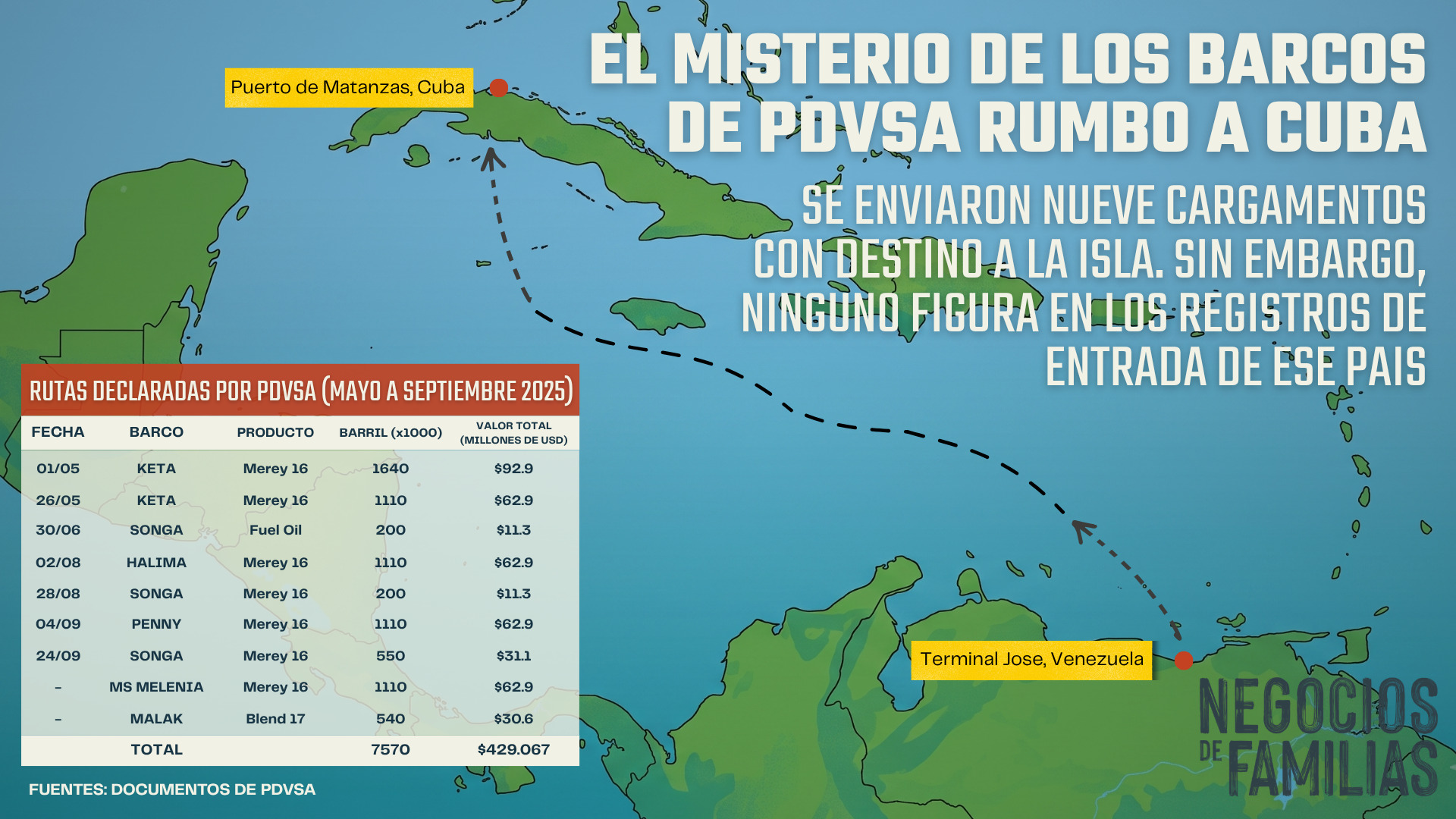
The internal Pdvsa documents obtained for this investigation confirm that while Cuba faced an electricity generation deficit, between May and September 2025, at least eight of these fuel shipments were received from Venezuela by Cubametales. The ships transported crude oil and fuel oil worth approximately 429 million dollars, based on the average price of Merey 16 during 2025.
For instance, between May 1 and May 3, the tanker Keta loaded 1.64 million barrels of Merey 16 crude worth an estimated 92 million dollars at the Jose terminal, located on the northeastern coast of Venezuela, destined for Matanzas. On the 26th of the same month, that ship made another load with the same destination.
In the records of the following months, several shipments of Merey 16 crude appear dispatched towards the northern coast of Cuba in Pdvsa’s documents. On September 24, the vessel Songa (later renamed Neptune 6) reappears in the records of Venezuelan oil loading stations on June 30 and August 28, but this time with fuel oil loads.
However, none of these vessels’ voyages are recorded on maritime tracking platforms Marine Traffic and Vesselfinder, which were consulted for this investigation. These platforms confirm that from January to October 2025, around 96 vessels arrived in Matanzas. But their lists do not include any of the tankers registered in Pdvsa’s documents.
There is also no report of these vessels arriving at the port of Havana, where petrochemical ships dock with cargoes destined for the Ñico López refinery. Cienfuegos, which houses another important Cuban refinery, received 111 vessels during that time of the year, but the ghost tankers left no official trace there either.
The record of fuel ships arriving in Cuba in 2025, held by the Energy Institute of the University of Texas consulted for this investigation, also does not include these ships coming from Venezuela. Experts recorded six shipments of Pdvsa fuel between June and September 2025, but none correspond to the ten reported by the Venezuelan oil company destined for Matanzas during that year. Thus, the actual destinations of the vessels and their loads remain shrouded in mystery.
The tanker Malak is also mentioned in Pdvsa’s documents, heading to Cuba, on a voyage where Shineful Energy, one of the companies linked to Carretero, is listed as the consignee. The maritime tracking platform Global Fishing Watch shows Malak, flagged under the Comoros Islands, making 11 visits to Venezuelan ports between April 21 and December 21, 2025. The itineraries include stops in Jose, Cardón, Amuay, El Palito, Punta Guaranao, and Puerto Miranda, all ports in Venezuela. However, the platform does not show any of its routes leading to Cuba. The last recorded signal for Malak corresponds to December 2025.
Cuban President Miguel Díaz-Canel admitted in an interview in April that, since Maduro’s capture, the island’s economy had suffered due to the interruption of aid – mainly crude oil – coming from Caracas. This has resulted in a collapse of the Cuban economy, putting the Castro regime in front of a potentially terminal crisis.
In the same interview, Díaz-Canel avoided providing details on how much Pdvsa oil used to reach Cuba: “I won’t give you numbers because those are things that are closely pursued by American intelligence services to see how they can affect us. Besides, we haven’t renounced our right, like any other country in the world, to import fuel and for other countries to export fuel to Cuba,” he concluded.
Last December, when U.S. military vessels intercepted and confiscated the Skipper, Cuban authorities emphatically denounced this action, labeling it “piracy and maritime terrorism.” They also warned that the military operation seriously aggravated the energy crisis and blackouts on the island.
Had the ships that loaded in Venezuela but did not arrive in Matanzas during the summer of 2025 delivered their cargoes to Cuba, they could have alleviated the unbearable blackouts suffered by Cubans during those months. It remains to be seen how many more took unknown routes for probable commercializtion, while Havana blamed the national electrical crisis on fuel shortages and the blockade.
.
