The Court of Appeals of the Penal Judicial Circuit of Carabobo opened a new phase in the case against National Guard captain Juan Carlos Caguaripano Scott and 22 others convicted for the events that took place at Fuerte Paramacay in August 2017. The public hearing is set for Wednesday, August 26, 2026, at 11:00 AM, in Valencia.
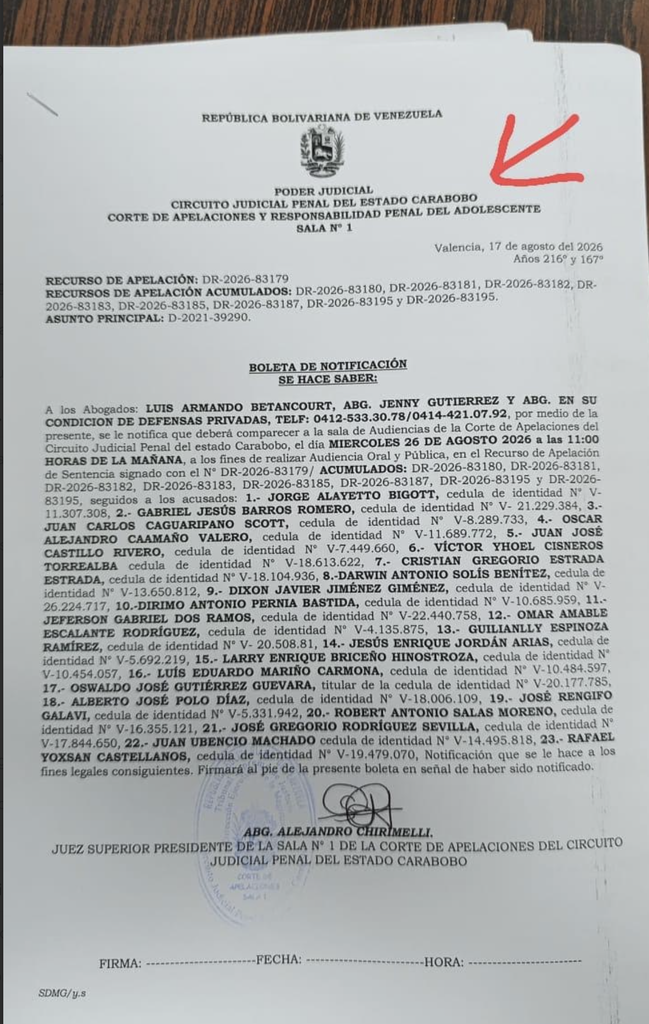
The notice was issued in a notification slip dated August 17, 2026, by Chamber No. 1 of the Appeals Court and Adolescent Criminal Responsibility of the Carabobo Penal Judicial Circuit. This document formally confirms that the appellate court will review the appeals filed against the sentence issued in the case.
This decision signifies one of the most significant judicial movements recorded in Caguaripano’s file, who was sentenced to 30 years in prison after being incarcerated for more than eight years. However, the notification does not equate to an acquittal or guarantee his release; it simply states that the Court will listen to the defense arguments and review the legality of the sentence.
The judicial document confirms the hearing
The slip indicates that the hearing pertains to the appeal identified with number DR-2026-83179, to which other related appeals have been added. The main issue is recorded under number D-2021-39290.
The document explains that defense attorneys must appear before the Appeals Court Hearing Chamber to participate in the public and oral act. This notification was signed by lawyer Alejandro Chirmelli, identified as the presiding senior judge of Chamber No. 1.
The notification includes 23 individuals processed in the case, including Juan Carlos Caguaripano Scott, Jorge Alayetto Bigott, Gabriel Jesús Barros Romero, Óscar Alejandro Caamaño Valero, Juan José Castillo Rivero, Víctor Yohel Cisneros Torrealba, Darwin Antonio Solís Benítez, Jefferson Gabriel Dos Ramos, and Robert Antonio Salas Moreno.
The presence of several accumulated appeals indicates that the Court will examine the challenges presented by the defenses of different convicts within the same legal act. This doesn’t mean that all will necessarily receive identical decisions, as the arguments and grievances raised may vary based on each accused situation.
The information was initially disclosed by journalist Víctor Ugas and later picked up by media outlets such as El Impulso and El Nacional. Both publications align with the essential data contained in the judicial slip: the identification of the resource, the number of accused, and the date set for the hearing.
What does the admission of the appeal mean?
The admission of the appeal means that the Court of Appeals has deemed the challenge to be processable and summoned the parties to hear their arguments. It does not imply that the judges have preemptively accepted the defense’s allegations or revoked the sentence.
Article 447 of the Venezuelan Organic Code of Criminal Procedure establishes that when an Appeals Court admits an appeal against a final sentence, it must set an oral hearing. During this act, lawyers present the grounds of the challenge, and the magistrates may ask questions regarding the issues raised.
The Organic Law of Reform of the Organic Code of Criminal Procedure explains that a sentence may be appealed for alleged violations of trial norms, lack or contradiction in the reasoning, procedural breaches capable of causing defenselessness, use of illegally obtained evidence, or incorrect application of a legal norm.
The regulation also states that the Court may decide at the end of the hearing or, if the complexity of the issue prevents it, within the following ten days. Thus, it cannot be stated that on August 26 there will necessarily be a release or a definitive sentence.
The scenarios facing Caguaripano
The Appeals Court has several possibilities. It may reject the appeals and confirm the convictions; accept some of the arguments and annul the sentence totally or partially; order a new trial before a different court; correct the imposed penalty; or render its own decision when the issue is limited to the interpretation or application of the law.
If the decision determines that the deprivation of liberty for any of the accused should cease, Article 450 of the Organic Code of Criminal Procedure orders the Court to arrange for their release. This possibility exists in law, but it will depend on the content of the appeals, the arguments developed by the defenses, and the ruling adopted by the judges.
The analyzed slip does not detail the specific reasons invoked by each lawyer. It also does not contain an order for release, a reduction of sentences, or a declaration of the innocence of the accused. Presenting the notification as a release already agreed upon would go beyond what the document actually indicates.
A process initiated after the events in Paramacay
Juan Carlos Caguaripano became one of the most recognized figures in Venezuelan military dissent following the events of August 6, 2017, at Fuerte Paramacay, the headquarters of the 41st Armored Brigade of the Army, in Naguanagua, Carabobo state. The action was presented by its participants as “Operation David” while the authorities labeled it an attack on a military installation.
Caguaripano was arrested days later and remained imprisoned throughout a process characterized by extensive delays. The case gathered military and civilians accused of their alleged participation in the events, including individuals who have been recognized as political prisoners by human rights organizations.
The case progressed over the years amid postponed hearings, procedural actions, and complaints from family members and lawyers about alleged irregularities. The defense will now need to use the appeal hearing to demonstrate which legal or procedural flaws, in their opinion, affect the validity of the conviction.
A key date, but not the end of the process
The August 26 hearing once again places Juan Carlos Caguaripano’s case under public scrutiny. The Court must examine whether the sentence meets the guarantees of due process, if it presents sufficient legal reasoning, and if the evidence was obtained and incorporated in accordance with Venezuelan law.
The judicial act could pave the way for the annulment of the conviction, the holding of a new trial, the modification of penalties, or the confirmation of the ruling. Even after the Court’s decision, there could still be new actions, including a potential casation appeal to the Criminal Chamber of the Supreme Tribunal of Justice, depending on the content of the ruling.
For now, the verifiable fact is that the appeal will be publicly debated on August 26. The judicial slip confirms the date and the summoned accused, but does not anticipate the outcome. Attention will be on the arguments of the defenses and the response of a Court that must resolve a file marked by nine years of imprisonment, procedural questioning, and demands for justice.