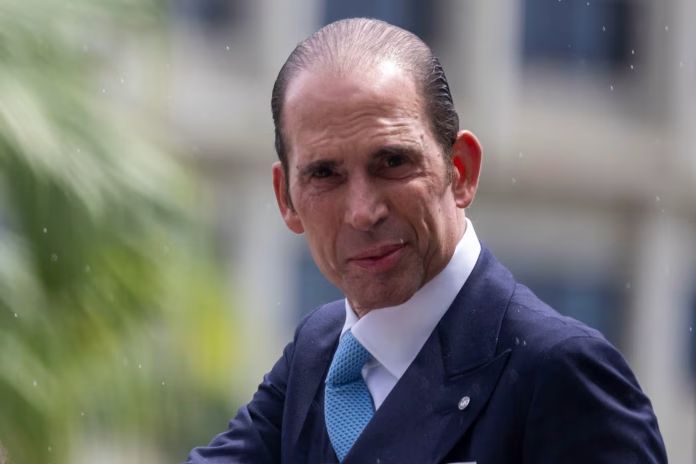
 Julio Herrera Velutini
The Venezuelan banker Julio Herrera Velutini celebrated the presidential pardon granted by Donald Trump in the federal case involving former Puerto Rican governor Wanda Vázquez Garced, calling it a “benevolent” pardon amid ongoing questions about his financial and political history in the United States, United Kingdom, and Venezuela.
Through his attorneys Lilly Ann Sánchez and Christopher Kise, Herrera Velutini stated that he is “deeply grateful” to Trump for the pardon, expressing his hopes to “move on with his life and devote time to his family and career.” The lawyers emphasized that the term “benevolent” indicates goodwill towards people, as defined by the Royal Spanish Academy.
The presidential pardon, reported by U.S. media citing official White House sources, also benefits former federal agent Mark Rossini, the third individual involved in the case. Vázquez Garced’s attorney, Peter John Porrata, publicly confirmed the granting of the pardon, while reports indicated that Trump believes the judicial proceedings were motivated by “political persecution.”
The news came just days after it was disclosed that Isabela Herrera, the Venezuelan banker’s daughter, donated one million dollars to the MAGA Inc committee, only 37 days after the defendants reached a plea agreement with the U.S. Department of Justice. This agreement downgraded the public corruption case to a lesser charge of an electoral nature. Previously, Isabela Herrera had donated an additional 2.5 million dollars to the same committee in 2022, as revealed by the newspaper El Nuevo Día.
Vázquez Garced was accused in August 2022 of public corruption. According to federal charges, Herrera Velutini and Rossini promised financial support for the then-governor’s political campaign in 2020 in exchange for her using her influence to remove the director of the Office of the Commissioner of Financial Institutions (OCIF), which was investigating Bancrédito, owned by Herrera Velutini.
Under these circumstances, Herrera Velutini resigned as president of Bancrédito upon the announcement of federal charges against him, which included conspiracy, bribery, and electronic fraud, after which the bank ceased operations in Puerto Rico.
Since 2015, the OCIF had issued warnings and demanded corrections from Bancrédito for regulatory non-compliance and suspicious operations, resulting in the bank entering voluntary liquidation ordered by the regulator and halting operations in 2022.
In February 2020, then commissioner Joyner Kelly allegedly resigned under pressure. Later, Vázquez Garced appointed Víctor Rodríguez Bonilla as his replacement, who, according to the indictment, had been recommended by Herrera Velutini. In return, the former governor allegedly received a bribe of 300,000 dollars, funneled through a study or survey linked to her electoral campaign.
The public corruption charges were dropped following the plea agreement reached by the three accused, who pleaded guilty in August to violating Title 52 of the U.S. Code, Section 30121, of the Federal Election Campaign Act (FECA), which prohibits corporations and foreign entities from making contributions or expenditures to influence federal elections. The sentencing hearing was scheduled for January 29, though it may be rendered moot by the pardon.
The same judicial case also involved Frances Díaz, president of Bancrédito, and John Blakeman, former political advisor to Vázquez Garced. Both pleaded guilty and cooperated with federal authorities, but have yet to be sentenced.
Background: the financial trail in Venezuela
Beyond the case in Puerto Rico, Herrera Velutini’s name carries long-standing allegations in Venezuela. As documented in the book El Gran Saqueo by Carlos Tablante and Marcos Tarre, the banker is listed among those responsible for the financial crisis that occurred between 2009 and 2011, a collapse that caused incalculable financial damage to the country.
His management at Helm Bank, through a trust linked to Seguros Banvalor, owned by the Castillo Bozo brothers, is highlighted as one of the clearest examples of how part of the Venezuelan insurance sector utilized trusts to obscure the source and destination of state funds, which were later diverted to tax havens through complex and opaque financial operations.
On December 19, 2008, just two months after the purchase of the bank and while awaiting approval from the Superintendency of Banks, an employee of Helm Bank filed a Suspicious Activity Report (SAR). This report raised alarms about five consecutive disbursements of four million bolívares each, transferred to companies established on the same day, with identical opening amounts, registered by the same lawyer, and with almost identical purposes.
Despite being newly established companies, they received multi-million dollar loans. Through this fictitious corporate structure, Herrera Velutini reportedly granted himself a self-loan totaling 20 million bolívares in a single day. Although the exact amounts diverted through this method were never precisely determined, various estimates suggest that millions of dollars were funneled to tax havens using the Seguros Banvalor trust as a financial vehicle.
Currently, Herrera Velutini resides in the United Kingdom, where he controls his financial ventures—including Britannia Financial Group—maintains an extensive political connection network, and manages a fortune estimated at 1.6 billion dollars.
Judicial documents and international reports indicate that from 2019 to 2022, Herrera Velutini and his firm Britannia Financial Group donated over 500,000 pounds sterling to the UK Conservative Party (Tory), sparking concerns about the banker’s relationship with British politics and potential transnational influences.