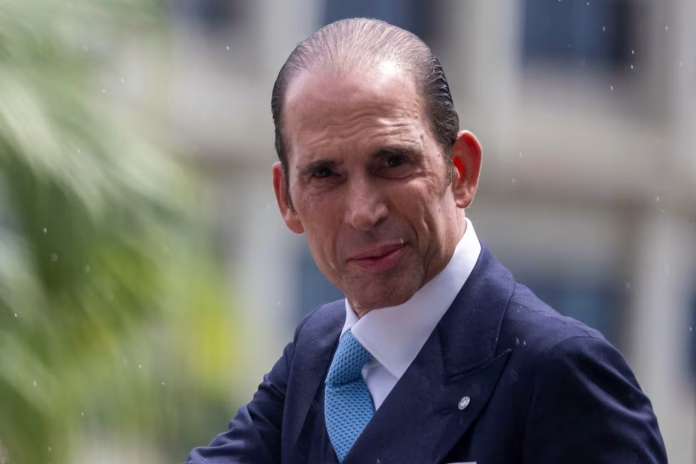
 Julio Herrera Velutini
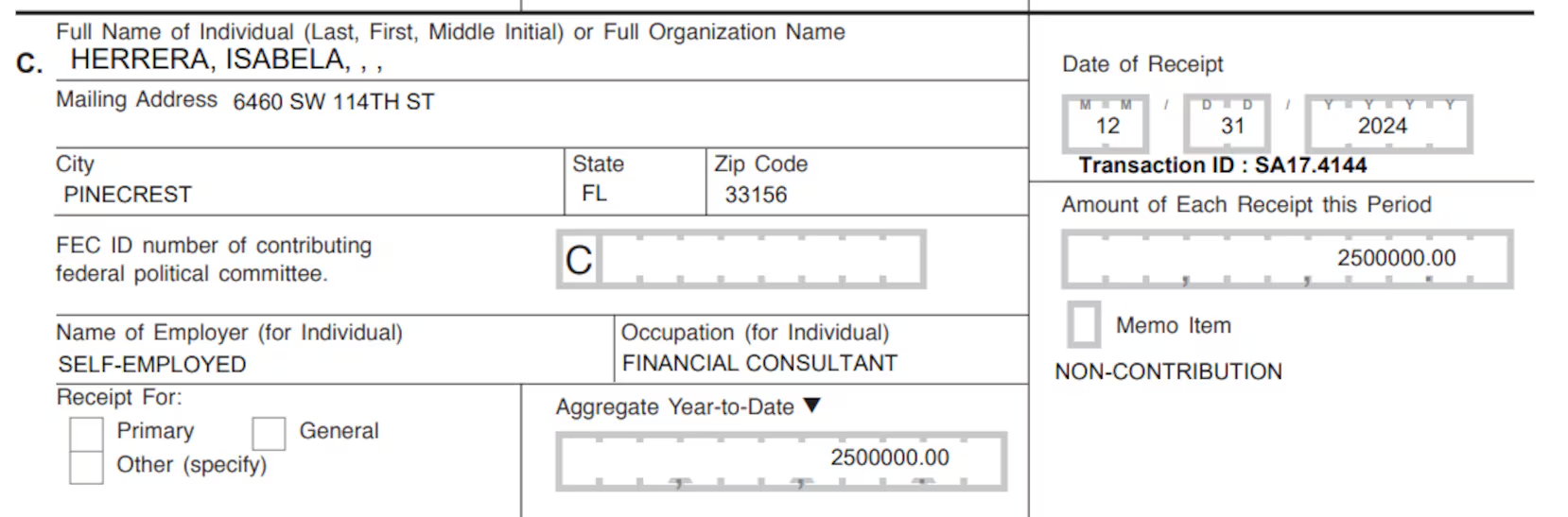
Financial consultant Isabela Herrera, daughter of the convicted Venezuelan banker Julio Herrera Velutini, owner of Bancrédito International Bank & Trust Corporation, donated $2.5 million to the political action committee MAGA Inc. at the end of 2024, according to official records from the U.S. Federal Election Commission (FEC).
The donation was received on December 31, 2024, according to a document published on the digital platform of the FEC, which requires political action committees to report their incomes and expenses. MAGA Inc. (Make America Great Again) was established in 2022 by allies of U.S. President Donald Trump with the aim of raising funds for political activities and the Republican Party, ahead of the campaign that brought him back to the White House.
This information surfaced in a report by The New York Times, which revealed that since Trump was elected for a second time, he and his associates have raised nearly $2 billion for various political causes. The article details that over $500 million of these funds can be traced back to just 346 donors who contributed at least $250,000 each.
According to the investigative journalism report, more than half of these large donors have benefited —or are linked to sectors that have benefited— from decisions, policies, or statements from the U.S. president, the White House, or federal agencies, rekindling the debate about the influence of private money in U.S. politics.
In relation to the legal case of Herrera Velutini, a spokesperson for the Department of Justice denied that the $2.5 million donation to MAGA Inc. was linked to the agreement reached in the criminal case where the banker pleaded guilty along with former Puerto Rico governor Wanda Vázquez Garced and former FBI agent and financial advisor Mark Rossini. “The decision to resolve this case was made through proper channels and was not influenced by any donation to MAGA Inc.,” the spokesperson told the U.S. media.
However, John D. Keller, former head of the Division of the Department of Justice that handled the case and who subsequently resigned in protest, described the difference between the reached agreement and the more than 20 years in prison that Herrera Velutini would have faced if the original charges were proven as “shocking.” In statements quoted by The New York Times, Keller argued that the case “appears to be another example of political considerations dictating the outcome of an individual criminal process.”
This judicial history is accompanied by a new legal controversy. In July 2025, a U.S. law firm sued Herrera Velutini in a federal court in Manhattan, claiming that the banker owes around $500,000 in legal fees for services rendered during the initial phase of his criminal case. As reported by Reuters, the firm —which withdrew from the case in May 2024— asserts that, despite having worked on his defense when he faced bribery, conspiracy, and electronic fraud charges, they did not receive the payment due. Subsequently, Herrera Velutini hired other high-profile attorneys to continue his defense.
Among those attorneys is Christopher Kise, one of Trump’s main legal representatives, who defended him both in the criminal case regarding classified document handling —later dismissed— and in the civil fraud process in New York related to his companies.
The criminal case against Herrera Velutini dates back to August 2022 when a federal grand jury charged the banker, along with Vázquez Garced and Rossini, for an alleged bribery scheme related to the 2020 electoral campaign in Puerto Rico. Together, they faced charges of conspiracy, bribery in federal programs, and honest services fraud. In the case of the Venezuelan banker, additional charges were linked to a separate bribery scheme.
After a meeting with senior officials from the Department of Justice in Washington D.C. in May of this year, the co-defendants and the federal prosecutor reached an agreement to avoid trial, which was scheduled for August. As a result, a new charge was presented that reduced the case to a single misdemeanor charge under the Federal Election Campaign Act (FECA), related to the acceptance or promise of foreign contributions for a political campaign in the United States.
In August, the three co-defendants pleaded guilty before federal judge Silvia Carreño Coll and are currently awaiting sentencing hearings scheduled for 2026. In an order issued in July, the magistrate noted that the penalty for violating Section 30121 of the FECA constitutes “a mere slap on the wrist” compared to the sanctions they would have faced if the original charges succeeded, although she acknowledged that the change in direction of the case falls within the procedural discretion of the federal government.
Meanwhile, Vázquez Garced’s defense argued in a motion filed in August that the agreement with the federal prosecutor was due to the existence of “new compelling and exculpatory evidence” and not political pressure. According to this argument, the federal government never alleged external interference or forced capitulation, but rather voluntary and professional negotiations.
The original accusation claimed that Vázquez Garced, Herrera Velutini, Rossini, and other persons not formally charged participated in a bribery scheme whereby the then-governor allegedly replaced the head of the Office of the Commissioner of Financial Institutions (OCIF), George Joyner, with an official favored by Herrera Velutini, in exchange for political contributions and consultancy contracts. This change was said to have occurred following investigations by the OCIF into alleged regulatory violations by Bancrédito.