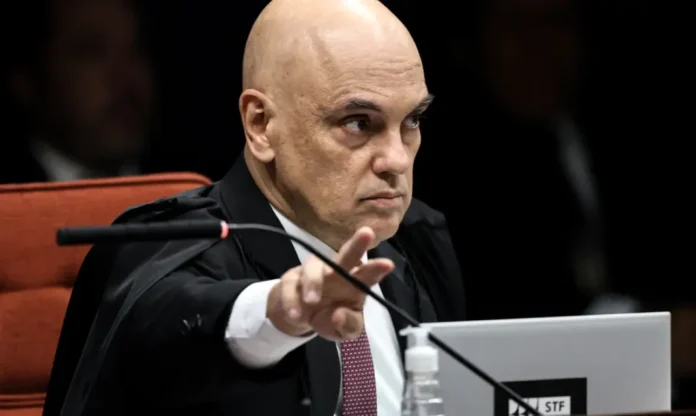
 Alexandre de Moraes, judge from Brazil – Photo Agência Brasil
Justice is not blind in Brazil. At least not when family businesses are involved. What has been portrayed for years as a series of court decisions “in defense of democracy” is starting to reveal an uncomfortable truth: economic ties and multi-million contracts weigh just as much—or more—than constitutional principles. With information from ICN Diario.
The new controversy points directly at Alexandre de Moraes, one of the most influential judges in the country and a central figure in the Supreme Federal Court (STF). This time, the scrutiny is not limited to his judicial decisions, but extends to the direct involvement of his family surrounding with a financial entity currently under investigation for massive fraud.
Banco Master is under scrutiny for alleged schemes involving fake credits, fraudulent bonds, and a financial hole of billions of reais that led to its collapse, the arrest of its CEO, and a direct impact on the stability of the Brazilian banking system. The investigation is spearheaded by the Federal Police as part of Operation Compliance Zero.
As these investigations progressed, the law firm of Viviane Barci de Moraes, the judge’s wife—which also includes his children—was maintaining an active contract with the bank controlled by businessman Daniel Vorcaro. The agreement was substantial: it involved payments of 129 million reais (around 25 million dollars) over a span of three years, translating into monthly income of 3.6 million reais for the judge’s family.
The timing is hard to ignore. While the bank faced criminal and regulatory accusations of serious nature, the judge’s family, wielding one of the greatest powers within the Brazilian judicial system, received large sums of money. The question is unavoidable: was this merely a legal advisory role or an institutional lifeline for an entity on the brink of collapse?
The situation becomes even more delicate upon learning that during this same period, Moraes held meetings with the Central Bank of Brazil, just as Banco Master faced crucial regulatory processes. In response to public pressure, the judge’s defense offered an explanation that was as striking as it was controversial: these meetings, they insisted, were unrelated to the bank, but rather concerned discussions about the application of the Magnitsky Law.
The Magnitsky Law is a U.S. regulation designed to sanction human rights violators and those responsible for corruption. Analysts argue that using it as a justification in this context is not only implausible but also offensive to public intelligence. Even more so when Moraes himself has been mentioned in international discussions regarding possible sanctions. The invocation of human rights language seems to serve as a cover for what appears to be high-level lobbying for a bank under investigation.
The scheme is circular and suffocating: Banco Master is investigated for massive fraud; the judge’s wife receives a multi-million dollar contract from that same entity; the judge meets with the monetary authority in the midst of regulatory processes; and the official explanation relies on international sanctions that have nothing to do with banking oversight.
In any other court, such a scenario would warrant immediate removal from office. In the STF, however, the last name seems to confer a kind of ethical immunity. Brazil cannot afford a justice system operating with a double standard nor a judiciary perceived as serving private interests.
The shadow surrounding Alexandre de Moraes today is no longer confined to his controversial decisions. It has a name, concrete figures, and an unmistakable scent of family privilege that threatens to further erode the institutional credibility of the country’s highest court.