On November 9, 2025, Panama woke up to a scandal that could no longer be swept under the rug: a rusty tugboat, bearing an African flag and carrying a load of 13.5 tons of cocaine, revealed not only an international drug trafficking operation but also an institutional protection network woven from the highest levels of Panama’s maritime power.
The tugboat, named Oceanic Tug, was intercepted broad daylight by the National Aeronaval Service (SENAN) near San José Island, in the Pearl Archipelago. Four smaller boats were escorting it, reportedly used for previous loadings at sea. When agents boarded the vessel, they found no secret compartments or sophisticated naval engineering. Just stacks of 579 packages of high-purity cocaine, almost insolently piled up.
The crew, made up of ten men aged between 70 and 73 and hailing from six different nationalities, offered no resistance. Exhausted, they surrendered without protest. Their lawyers later claimed they were recruited under death threats: “retired men forced into the organized crime.”
What truly shook the nation, however, was not the drugs but the name behind the boat: Pablo E. Torres Chong, one of Panama’s most influential maritime businessmen.
A businessman with history and power
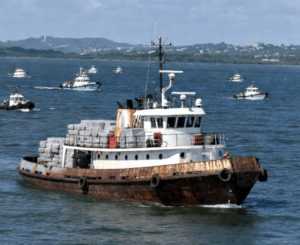
Oceanic Tug
The Oceanic Tug was not a ghost ship. It was purchased in 2022 by Dolphin Tugs Inc., a company founded in 2019 and headed by Torres Chong. In 2023, it was transferred to Power H Holding Corporation and then to Pacific Tug & Barge Operators. Finally, in 2024, the Panama Maritime Authority (AMP) canceled its registration, after which the vessel reappeared under the opaque Tanzanian flag.
The transfer process was overseen by the law firm Maritime Lawyers Bureau, which was surprisingly dissolved in August 2024, adding more legal murk to the case. Although Torres Chong claims to have sold the boat in March 2023 “with all formalities,” the timeline, intermediaries, and his history of government benefits under PRD administrations raise another hypothesis: the boat wasn’t lost; it was protected.
With more than two decades in the business, Torres Chong is the CEO of Stward Corp., a company that controls the lucrative business of supplying fuel to cruise ships (bunkering) in Amador, an operation that —according to sector sources— enjoyed expedited permits and unusual privileges.
The political web
Torres Chong’s power extends beyond the business realm. He is a cousin of former PRD deputy Ricardo Torres and is close to former President Laurentino Cortizo. His rise coincided with a series of maritime concessions under officials like Noriel Araúz (former AMP administrator), Gabriel Carrizo (former vice president), and Freddy Torres de Santiago (political operator).
In 2021, lawyer Helga Ceballos filed criminal charges against the AMP for corruption, directly pointing to Torres Chong in alleged administrative irregularities. Among the most controversial:
Occupation of Dock 8 of the Balboa Shipyard.
Approval of maritime license after a fuel spill.
Monopolization of bunkering in Amador, consolidated in 2024.
Even former President Ricardo Martinelli publicly accused him: “Pablo ‘The Tug’ Torres has always been a drug dealer. He needs to have all concessions taken away.” Torres denied everything, without resorting to legal claims.
Resignation under pressure
Three days after the seizure, on November 12, Torres Chong resigned “for personal reasons” from his position on the board of the Panama Maritime Chamber (CMP). The CMP responded by requesting an “objective and transparent” investigation, although within the guild, the resignation was perceived as an act of weakness or a preventive measure to avoid formal expulsion.
Meanwhile, the Public Ministry, under Prosecutor Julio Villarreal, is continuing the investigation. For now, only the crew has been charged, but the case points to three fronts:
The Colombian origin: Clan del Golfo laboratories in Juradó.
The Panamanian route: used from the Gulf of Chiriquí.
The logistical support: history of the ship, owners, and ties with the AMP.
Audits of concessions awarded to companies related to Torres Chong are being considered. The fear of a “domino effect” in Panama’s maritime sector —vital for global trade— is mounting.
Public outrage
On social media, the case sparked a wave of outrage: “Ten retirees in jail and the ship owner giving interviews? Panama has two justice systems: one for the poor and another for the powerful.”
Sarcasm also went viral: “Tugboat for sale, almost new, only 13 tons of use.”
But the public narrative is clear: this is not just a story about drug trafficking. It is a symptom of a rotten system. One that allows ordinary vessels to become highways for organized crime, protected by political, business, and legal power structures.
Will the State dare?
The Oceanic Tug sailed for years among papers, favors, foreign flags, and concessions. This time, it could sail no more. What it carried was too big to hide, even in a country accustomed to bureaucratic opacity.
The case is no longer just about cocaine. It’s about an elite that believed themselves untouchable. About a country where the sea unites continents but also washes away sins.
Panama faces a historic decision: let the waves carry away the truth… or finally sink the ship of impunity once and for all.
The investigation has only just begun. If the waves of justice finally arrive, they shouldn’t spare anyone.
Maibort Petit