Stephen Miller has been a central figure in Donald Trump’s inner circle for several years. Currently, he serves as Deputy Chief of Staff and advisor focused on domestic national security. Photograph: Gage Skidmore.
Jorge Barragán is an international analyst who graduated from the Central University of Venezuela (UCV).
Guacamaya, October 14, 2025. Stephen Miller, arguably President Donald Trump’s most trusted aide, has become the pivotal ideological and most powerful person in the White House during this second term.
Typically, every president has a favored advisor, and for Trump, that individual is Miller, who holds the titles of Deputy Chief of Staff and advisor for domestic national security policy. Notably, he is the only close aide who was also present during Trump’s first term. Experts liken his influence to that of Dick Cheney (the incredibly powerful vice president to George W. Bush) due to the unparalleled control he wields over government policies.
The clearest indication of his status comes from Trump himself: when questioned on NBC’s Meet the Press about the prospect of naming Miller as National Security Advisor, Trump rejected the notion, claiming it would be a “demotion” since “Stephen is much higher up in the hierarchy” of his administration. In effect, Miller has a direct line of authority to the president, even more so than other senior officials.
The Ideologue Behind Trump’s Anti-Immigration Agenda
As the mastermind behind hardline immigration policy, Miller has influenced Trump’s most controversial and prominent initiatives, both in his initial term and now.
During the time out of office (2021-2024), Miller was not idle: he founded America First Legal, an organization aimed at defending the “America First” agenda in the courts. From this platform, he analyzed how to implement Trumpist policies more effectively while bypassing the judicial checks and balances that stymied many actions during the first administration. Indeed, Miller prepared to re-enter governance alongside Trump, strategizing how to navigate the legal and bureaucratic hurdles that had previously impeded them.
The agenda of Trump’s second term primarily reflects the ideas Miller has championed for years. Most of the most extreme immigration initiatives showcase his influence.
End of Birthright Citizenship: On inauguration day in January 2025, Trump signed an executive order (conceived by Miller) that abolished birthright citizenship (jus soli) for children born in the U.S. to undocumented immigrants.National Emergency and Border Militarization: Miller advocated for declaring an “invasion” at the southern border to invoke emergency powers. Under his directive, National Guard troops were deployed under the guise of combatting crime connected to immigration. This included the cancellation of TPS (Temporary Protected Status) and the imposition of a “travel ban” for certain nationalities, including Venezuelans.Detention Quotas and Mass Deportation: Following Miller’s orders, ICE and the Border Patrol operated under aggressive arrest and deportation targets. In May 2025, Miller set a quota of 3,000 daily immigrant detentions, leading to operations in restaurants, courts, and even hospitals to apprehend undocumented individuals, fostering panic in migrant communities and straining relations with local Democratic authorities.Crackdown on “Sanctuary Cities” and Democratic States: Under Miller’s guidance, heavily armed federal forces were deployed in cities with elevated crime rates (Chicago, Philadelphia, etc.) with the claim of “restoring order,” a contentious strategy that Democrats labeled militarization for political purposes.Designation of Cartels as Foreign Terrorists: One of Miller’s longstanding proposals, enacted in this administration, was to classify specific international drug cartels as Foreign Terrorist Organizations (FTO). This notably includes the Tren de Aragua. The “terrorist” designation is intended to provide extraordinary combat tools (including direct military actions) against these groups, a historic deviation from traditional anti-drug strategy. As outlined later, this designation carries significant legal consequences for Miller’s immigration agenda.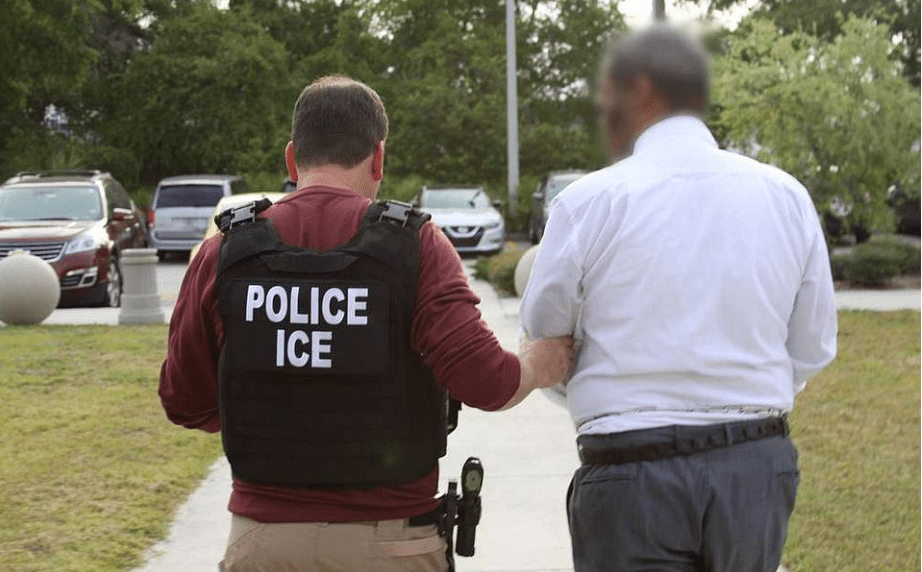 Stephen Miller is the primary ideologue behind the anti-immigration and mass detention agenda in the United States. Photograph: Defense Visual Information Distribution Service.
Ideological Vision from an Early Age
While attending Santa Monica High School, Stephen Miller gave a speech that generated significant discussion due to its provocative nature, hinting at traits of his future political views. In a video made for an audiovisual class during his candidacy for student government, Miller stepped to the podium and remarked:
“Hi, I’m Stephen Miller. Some of you may not know me… I would say and do things that no one in their right mind would say or do. Am I the only one who is tired of being told to pick up trash when we have so many janitors who are paid to do it for us?”
Critics interpreted this remark about janitors as classist and racist, given the demographics of those occupying those jobs.
This incident exemplifies his early attraction to controversy and showcases how, from a young age, Miller articulated a narrative of “us versus them” — a moral and cultural identity that he would later define in opposition to immigrants, minorities, and what he deemed “nationalist imperatives.”
According to the biography Hatemonger, his family faced financial hardships following an earthquake in the nineties, which forced the Millers to relocate to a less affluent neighborhood when Stephen was just 13 years old. This experience, instead of fostering solidarity, deepened in him an awareness of fragility and competition: it was during this period that Miller began to associate economic insecurity with the threat posed by the “other” — especially immigrants — viewing them as adversaries that must be combated, rather than understood.
Successes in Curbing Migration: Figures and Even Unexpected Praise
To this point, the hardline immigration campaign designed by Miller has produced results that Trump himself touts as his greatest success. As per official data from the Department of Homeland Security (DHS), during the first eight months of the administration, 2 million undocumented migrants have departed the United States — around 1.6 million are believed to have self-deported due to pressure, and 400,000 were forcibly deported by authorities.
These policies have noticeably impacted migration patterns. For the first time in over 50 years, the total immigrant population in the U.S. saw a decrease instead of growth. It dropped from a high of 53.3 million in January 2025 to 51.9 million in June — that’s a decline of 1.4 million in just a few months, according to Pew Research.
Bernie Sanders, who has critiqued Trump, acknowledged in an interview that “no one believes that illegal immigration is appropriate” and recognized the necessity for more secure borders. “We should stop illegal entry; it is wrong for people to cross the border like that,” Sanders stated on ABC News, endorsing Trump’s fundamental principle while also advocating for comprehensive immigration reform.
However, the Democratic senator cautioned that “If Trump deports 20 million people, he would completely ruin this country. Trump’s billionaire friends aren’t going to harvest our fields or work in the slaughterhouses,” Sanders voiced. These remarks illustrate how even opponents of Trump acknowledge the tangible impact of his border policies while fearing their excesses.
From the Courts to the Caribbean Strategy: The Controversial Alien Enemies Act
Despite the claimed “achievements,” Miller’s offensive against immigration has opened several fronts and sparked ongoing legal disputes. One of the most contentious is the invocation of the century-old Alien Enemies Act of 1798 to streamline deportations — an unprecedented legal maneuver driven by Miller that is currently being challenged in courts. This law empowers the president to deport or detain foreign nationals from hostile nations “whenever there exists a declared war, or an invasion or predatory incursion by a foreign country.”
Miller publicly justified it with gusto: “Venezuela is not a government, it’s a drug trafficking cartel running a country,” he declared, directly alleging that Maduro is “the head of the cartel” and that the Tren de Aragua is “controlling Venezuela.” Essentially, he argued that the United States is facing an external enemy (a narco-state) and thus can invoke war powers for self-defense, including expelling nationals from that country.
Given that there is no declared war or armed invasion, the court ruled that the government cannot invoke the 1798 law to deport Venezuelans. The Trump administration has vehemently appealed this decision, with Miller personally leading the legal team. This case could ascend to the Supreme Court, as the government argues that the infiltration by a narco-regime meets the criteria of “predatory incursion” per the law (something most judges have rejected).
Again, Miller’s hand is behind this intricate legal tactic, blending warlike rhetoric, military actions, and imaginative legal reasoning. In fact, the unusual U.S. military presence in the Caribbean this year closely aligns with this strategy. Officially, its mission is to intercept drug shipments; however, in practice, they have conducted extrajudicial assaults against vessels linked to Venezuelan drug trafficking.
According to The Guardian, Miller has personally overseen these operations targeting Venezuelan boats, stepping into a role surpassing even the Secretary of State and the interim national security advisor, Marco Rubio. By consolidating control over these actions in his own council (HSC), Miller ensures the establishment of faits accomplis that reinforce the legal argument that “the United States is under attack by a foreign entity.” The deployment of marines and missiles in the Caribbean thus becomes a cornerstone of the self-defense rationale under Article II of the Constitution that the White House employs to justify deportations and attacks. In summary, Miller is attempting to assert that a state of low-intensity war exists against an enemy “narco-state,” making extreme measures seem legitimate.
Miller’s influence is also clear in the crucial bureaucracy surrounding these initiatives. Take the State Department, for instance, where Miller successfully positioned Christopher Landau as Undersecretary, a former ambassador now nicknamed “the visa remover” on social media for his fervor in canceling visas. Landau is a Miller ally, and his mission at the State Department has been “to control the flow of foreigners entering the United States,” according to internal sources reported by The Guardian.
Miller’s Strategic Calculus: Between the Caribbean, the Courts, and the Southern Border
The U.S. military deployment in the Caribbean, officially framed as an anti-drug operation, carries a much deeper legal and political context: it serves as the linchpin of Stephen Miller’s strategy to uphold the Alien Enemies Act against Venezuelan migrants in court. By portraying the Maduro regime as a “narco-state” engaging in hostile actions against the U.S., Miller aims to create faits accomplis that validate his assertion of foreign aggression, thereby activating war powers. Within this framework, military actions are not merely security responses but also legal and narrative instruments.
However, Miller is confronted with a delicate predicament. A potential “phase two” of the operation, involving attacks within Venezuelan borders, could trigger a new, massive wave of migration towards the United States. This would jeopardize what has been touted as his greatest achievement: the historic reduction in migrant flow at the southern border. A combination of a severe humanitarian crisis in Venezuela along with legal losses in U.S. courts could spell disaster.
His capacity to navigate between the courts, military deployments, and Trump’s political messaging positions him as the genuine “Rasputin” of this administration. However, it also underscores the precariousness of his strategy: any miscalculation, any migration surge triggered by impulsive military actions, could transform his most significant success into his gravest liability.