The request extends beyond merely allowing interrogations. It encompasses access to documentation, financial traceability, and, where feasible, transfer methods, which is particularly sensitive in Venezuela due to the constitutional ban on extraditing nationals.
The United States has formally presented a demand to Delcy Rodríguez that exceeds the simple capture of Nicolás Maduro and Cilia Flores, facing little apparent resistance. This cooperation, according to sources, revolves around a list of nine individuals of interest, chosen for their evidential value and their utility in reconstructing the network of contracts, money laundering, and political protection that Washington attributes to the former regime led by Maduro, much of which remains intact.
In practice, the White House proposes a three-layer exchange framework. The first layer is access: facilitating interviews, interrogations, administrative reviews, and sensitive documentation. This phase includes last week’s interrogation of Alex Saab, long identified as a Maduro operator, and businessman Raúl Gorrín. The second layer aims to enable U.S. teams to participate in or oversee parts of the verification work without Caracas publicly acknowledging it. The third layer, if deemed politically viable, contemplates transfer or delivery methods, with utmost care to avoid the word extradition.
Potential Alternatives
The underlying issue is constitutional. Venezuela does not extradite its nationals. This limitation forces cooperation into a gray area. Options being considered include administrative expulsions, agreed exits, transfers for security reasons, temporary detentions with interviews, and the provision of documentation. If the targets travel outside the country, their capture might also be possible, as occurred with Saab, who was detained in Cabo Verde in 2020, extradited to Miami, and later pardoned by Joe Biden.
According to sources, Washington is aware of this and prioritizes targets whose nationality, travel history, or positions within the structure leave more room for negotiation.
The list, the source insists, is not public and isn’t framed as an ultimatum, but functions as one. Rodríguez, who has not yet been formally charged by the U.S., receives the list as a condition for normalization. This list is tied to the recognition of the diplomatic mission in Caracas, selective unblocking, operational permits, and an energy agenda. In exchange, Washington demands progress on specific names and files. The agreement, if that’s what it can be called, is measured in verifiable actions: completed interrogations, provided documentation, traced accounts, identified companies, frozen assets, and potentially, transfers.
Alex Saab, the Most Valuable Piece
There are no photos, no official reports, and no public confirmation regarding Alex Saab and Raúl Gorrín’s current situations. For Washington, this is compatible with the objective of obtaining information without sparking an internal war in Venezuela over who controls detainees, which could provoke a crisis for Rodríguez at this time.
Saab, in particular, has evolved into the most valuable and troubling asset. The source describes him as the man who knows where the money is and how it moved. He is not just a contractor; he was a minister, an intermediary, and a link to the political core of Maduro’s regime for years. The U.S. has linked him to corruption networks associated with public contracts, and he has been charged in the past for bribery and money laundering schemes.
What changes now is the focus. ABC has learned that the Justice Department is reviewing an additional investigation into a suspected bribery conspiracy related to inflated food import prices. In the prosecutors’ minds, the food program is not a humanitarian episode, but a cash cow.
Delcy Rodríguez, according to sources, removed Saab from the cabinet upon assuming the interim presidency precisely because of this risk. Saab knows not only operations, but also decisions, names of ministers, high-ranking officials, companies, intermediaries, and banks, plus the mechanism that turned an import contract into commissions and those commissions into assets outside the country. The recent interrogation, sources contend, aimed to confirm the money trail and gauge his willingness to cooperate. The FBI has also become involved in his case, investigating him in Miami for matters unrelated to those he was charged with before his pardon.
Raúl Gorrín follows a similar path for different reasons, as he represents the architecture of currency control. In the U.S., he is accused of a bribery scheme to gain privileged access to currency operations and subsequently launder the money through shell companies and financial circuits. For Washington, Gorrín helps to explain the machinery that transformed an administrative decision into billions—who assigned, who authorized, who collected, who opened accounts, and who bought protection.
The Other Names
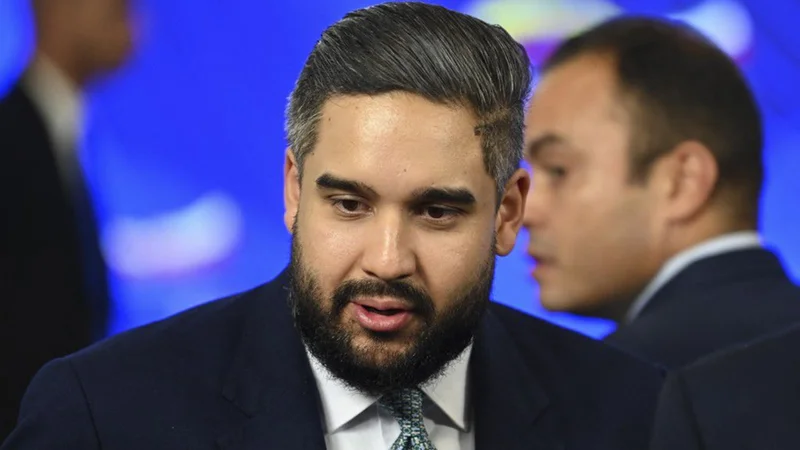
The nine names on the list include profiles that, due to criminal charges, sanctions, or operational knowledge, can support investigations or enhance seizures. Among them is Nicolás Ernesto Maduro Guerra, Maduro’s son, included in the extensive U.S. criminal file that accuses the power core of conspiracies linked to narcotics and arms, also subject to sanctions. For Washington, he is a family and patrimonial piece, with potential evidential value if access to communications, assets, and networks is obtained.
Also listed is Walter Jacob Gavidia Flores, Maduro’s eldest stepson, sanctioned by the Treasury for his alleged role in the commission ecosystem associated with public contracts. From the U.S. perspective, he is a gateway to assets and the web of shell companies and frontmen that, according to Washington, expanded in response to the import program and discretionary allocation of contracts.
The rest of the list extends into two fronts. One concerns purged individuals already under the control of the Venezuelan apparatus before Maduro’s capture. This includes Tareck El Aissami and Samark López Bello, who have been purged, detained, and prosecuted in Venezuela as of 2024 in a corruption case. Washington sees them as available targets because Caracas can authorize access to interrogations and documentation without needing to locate them.
El Aissami has been on the U.S. radar for years due to drug trafficking and sanctions violations. López Bello, presented as his financial operator and alleged frontman, draws interest because of the business network, properties, intermediaries, and payment routes that Washington seeks to reconstruct.
The other front involves profiles of information and security. This category includes Pedro Luis Martín-Olivares, former head of economic intelligence, indicted in the U.S. for drug trafficking and eligible for rewards. Washington links him to the institutional coverage of routes and cargo protection. While there are no public records of a recent detention, his inclusion, as sources indicate, points to what the U.S. believes is missing to close the loop: witnesses with internal knowledge of security operations and the chain of command. Alongside these seven high-ranking officials, two other senior officials are under investigation in the U.S., whose identities remain undisclosed.
The man who knows where the money is and how it moved. He is not just a contractor; he was a minister, an intermediary, and a link to the political core of Maduro’s regime for years.
Accused of a bribery scheme to gain privileged access to currency operations and subsequently laundering money through shell companies and financial circuits.
The son of Maduro, included in the extensive U.S. criminal file that accuses the power core of conspiracies linked to narcotics and arms and also subject to sanctions.
Maduro’s eldest stepson, sanctioned by the Treasury for his alleged role in the commission ecosystem tied to public contracts.
Purged, detained, and prosecuted in Venezuela in 2024 as part of a corruption case, having served as Minister of Industry and National Production and as president of the state oil company PDVSA.
A businessman marked as a frontman for former Minister Tareck El Aissami, who is also detained in Venezuela. For this reason, the U.S. Justice Department believes it can easily interrogate him.
Former head of economic intelligence, indicted in the U.S. for drug trafficking and eligible for rewards. Washington connects him to institutional coverage of routes and cargo protection.
The Dilemma of Delcy Rodríguez
Similarly, the source highlights two deliberate absences at this stage. The Minister of the Interior, Diosdado Cabello, is not currently included, even though he appears in U.S. cases, nor is Vladimir Padrino López, the Defense Minister, among immediate priorities. This is said to not be a political gesture, but rather an operational calculation. Washington seeks quick and verifiable results and prefers to start with those who can open financial routes, deliver documentation, or who are already under Venezuelan custody. It also aims to avoid forcing Rodríguez into an internal crisis by trying to neutralize two powerful figures who could retaliate.
This is the essence of the list—not a static snapshot, but a primary set of actionable demands. For Delcy Rodríguez, the dilemma is consistent with each name: to cooperate sufficiently to sustain normalization without exposing a U.S. oversight that could fracture her from within. For Washington, the logic is simpler: if there is measurable cooperation, there are reliefs and agreements; if there is none, the pressure for a second wave of attacks will return.